
How to Choose the Right Urban Sketching Course for You
- Blog
- April 16, 2026
- 37 mins
Wales or New York. Pubs or Barcelona. A junkyard or a safari. If you have ever scrolled our courses page and felt genuinely spoiled for choice, you are in good company. It is easily the most common question that lands in our inbox:
Which course should I actually take?
This post is here to help you figure out which one fits where you are right now.
Every one of Ian Fennelly’s courses teaches the same fundamental methodology, just through a different doorway. Some doorways are gentler. Some are bolder. Some take you straight into a busy scene and teach you to find the calm inside it. The right course is the one that meets you where you actually are, not where you think you ought to be. So let’s take a look.

Best for Complete Beginners: Where to Start When You Have Never Sketched Before
If the words “I cannot draw” are still sitting somewhere in your head, this is where to begin.
The Free Urban Sketching Course is exactly what it sounds like. A short introduction to the fundamental skills of urban sketching, covering materials, line work, the basics of perspective and the very beginnings of colour, followed by a full workshop so you can put it all into practice. It will not teach you everything, and it is not designed to. It is designed to give you a real taste of what it feels like to sit with a pen and start, before you commit a single penny to a longer course. Many of our community members started exactly here.
When you are ready to go deeper, the Urban Sketching for Beginners Course is the next step. It is a slower, more methodical course built around four locations in the historic English town of Shrewsbury. What makes it stand apart is the combination of pencil-first workshops and a dedicated set of skill-building exercises that sit alongside the main lessons. Starting in pencil means you can rub out, redo and be as wonky and indecisive as you like, and that is the whole point. The exercises let you practise hatching, perspective, pen work and more on a separate piece of paper before you ever apply them to your “proper” sketch. If perfectionism is the thing that has held you back, this course was written with you in mind.
I have always wanted to draw and paint and it's taken me until I'm 50 to find someone whom I understand. I love how the processes he shares are explained and it's very easy to follow. People that see my interpretation can't believe I produced it!
– Student Sharon N

Best for Simple Shapes with Bags of Detail
Two of our courses share something in common that makes them brilliant for building confidence: the structures are mostly flat facades. You are not wrestling complex angles or multiple vanishing points. Instead, the front face of the building gives you a simple, manageable shape to work with, and all the real fun comes from the layers of quirky detail you get to pile on top. Timber beams, hanging baskets, old signage, weathered window frames. It is the kind of sketching where you can lose an hour without noticing.
The High Street Sketching Course covers six everyday buildings, each chosen because it is the sort of thing you might walk past every week without a second glance. A Tudor cottage. A chip shop. A few high-street fronts. Ian’s whole point is that you do not need a famous landmark to produce a sketch worth framing. The simple shapes give you a solid foundation, and then he shows you how to find and draw the small details that bring a plain building to life, and just as importantly, which details to leave out so the page can breathe.
The Pub Sketching Tour is its cheekier cousin. Four real British pubs, each with a flat facade that acts as a natural grid for your sketch. The timber beams, the windows and the doorway hold the whole picture together without you having to think about perspective at all. Once that pressure is off, you are free to focus entirely on the character of the place: the old doorway, the hanging baskets, the signage, the worn stone. It is a wonderfully forgiving way into building sketching, no matter where in the world you live.

Best for Mastering Perspective: When the Vanishing Point Feels Like the Boss of You
When you are ready to face perspective head on, Robin Hood’s Bay Sketching Course is the one. Robin Hood’s Bay is a fishing village built into the cliffs of the North Yorkshire coast, with a steep main road that twists down to the sea and crooked little buildings stacked at every angle. There is almost nothing flat in it. Across six workshops and 73 lessons, Ian breaks down everything from the basic perspective of a sloping roof to the complex sweep of a whole street view. By the end of it, perspective stops feeling like a maths test and starts feeling like a tool you actually own.

Best for Colour: Learning Ian Fennelly's Approach to Palette and Mood
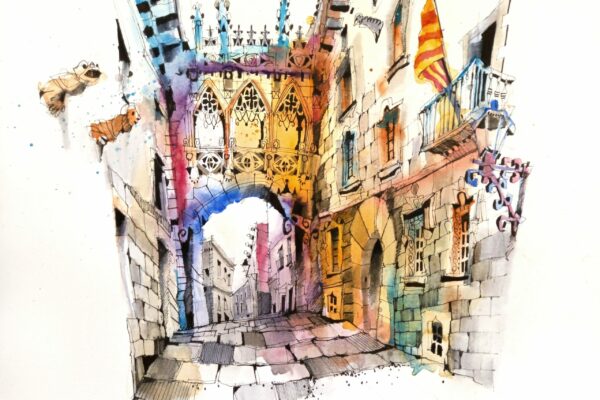
Colour is the thing most sketchers say they want help with. Sketch Barcelona is, quietly, our colour masterclass.
Yes, the Barcelona course covers Gaudi facades, Gothic architecture and Spanish colonial buildings, and yes the architecture is extraordinary. But the real teaching underneath all of that is colour. Across four workshops and 62 lessons, Ian shares the way he chooses, blends and applies the colours that make his sketches recognisable from across a room. You see how he picks a limited palette, how he loosens up his brushwork, and how he uses subtle nuances of warm against cool to give a sketch real character. If your sketches keep coming out a bit flat or a bit muddy, this is the one to add to your shelf
Great course and I'm learning a lot. Getting more confident in trying things out. Learning about colour, especially how less can be more. Lovely teaching style.
– Student Tracy W

Best for Loosening Up in Pen and Brush Pen
Ever flipped back through your sketchbook and noticed that every sketch looks a little bit over-cooked? Lines laboured over, details added that really should have been left out, colour pushed one layer too far? This is the course to reach for.
The Quick Sketch Course is dedicated to capturing scenes in 30 minutes or less, in black and white, using just pen and brush pen. Eight workshops, all built around the same core constraint: less time forces better decisions. You learn what to put down first, what to leave out, and how to suggest a whole scene with a few confident marks. It is also a wonderfully practical course for anyone who can only sketch in the gap between school pickup and dinner, or on a lunch break with a sandwich in one hand. The black-and-white element is a lovely bonus too, because it strips out the colour decisions and lets you focus purely on line, tone and rhythm.

Best for Storytelling: Capturing the Energy of a Scene
You have got the proportions right. The perspective is decent. The colour is in the right places. And yet the finished sketch just sits there, flat and polite, like a photograph you could have taken on your phone. The problem is not technical. It is that the sketch does not carry the energy of the place, the noise, the movement, the feeling you had when you were standing in front of it. Two courses tackle that specific gap.
Greatest Hits of London (Sketch London) teaches Ian’s 3-Phase Visual Framing Method. The whole idea is that great urban sketches do not capture everything in front of you, they capture the essence. The course is set against the noise and movement of central London precisely because that is where most sketchers freeze; too much movement, too many people, too many landmarks competing for attention. You will learn how to decide what to draw, what to skip, and how to finish a busy scene in under an hour without it looking crowded.

I just finished this from Ian's Greatest Hits of London course, this is Millennium Bridge in London. When I first look it just seems impossible, then as I go through the steps I always surprise myself. I can see a huge growth in my looking
– Student Ronda G
The Neighborhoods of New York course takes the same idea in a different direction. Ian deliberately stays away from the Empire State and the Statue of Liberty. Instead he sketches the corners, the crossings, the fire escapes, the benches; the spaces that people have just stepped out of. It is a course about how to make a sketch feel inhabited and full of life, even when there is not a single figure in it.

Best for Variety: A Course That Has a Bit of Everything
Some sketchers want to try a bit of everything without committing to a single subject. Castles one week, a harbour the next, then a rolling hillside. If that sounds like you, there is one course that was built for exactly this.
Sketch Wales is the biggest and most diverse course we have made. Eight workshops covering castles, churches, cottages, bridges, boats, harbours and mountains, all filmed on location across some of the most varied scenery in Britain. Within a single course you move from medieval fortresses to quiet harbours to open countryside and rolling landscape scenes, which means your sketchbook fills up with pages that actually look different from one another. Beginners can take it. So can confident sketchers looking to fill gaps.

Best for Transferable Skills: Taking Your Sketching Somewhere Unexpected
One of the most surprising things our students discover is that sketching something completely different from buildings can dramatically improve the way they sketch buildings. The skills transfer. The confidence transfers. And the way you see a subject changes for good.
The Safari Sketch Course looks, on paper, like an animal-drawing course; giraffes, elephants, zebras, vultures and baboons. In practice it is a course about learning to make better sketching decisions using forgiving subjects. Nobody is going to fact-check the angle of an elephant’s ear, so you are free to focus on weight, movement, mood and pattern. Many of our students report that their urban sketching improved more from this course than from any building course they have taken. Buildings start to feel less rigid. Animals feel less intimidating. Marks feel more intentional.

This one was a challenge from the very start. The structure, the eyes, the fur direction, the expression... it did not come easily. But I stayed with it and worked through the layers, slowly building tone and texture until it began to settle. I have learnt a great deal from this course as a whole. I am curious to see how these skills will influence me when I return to sketching a building again.
– Student Asmita K
What About Our Other Courses?
This guide covers the courses we think are the best fit for the most common sketching problems. But we have a wider catalogue too, including courses on landscape sketching, village scenes, portraits, the Wild West and more. You can browse the full range on our courses page
Final Thoughts
Every course we create is designed with a different focus in mind, whether that is perspective, colour, detail, speed, storytelling or something else entirely. The idea is that wherever you are in your sketching journey, there is a course that meets the specific thing you want to work on next.
If you are still not sure which one is right for you, get in touch. Our team is always happy to chat and help you find the best fit. Whichever course you choose, you are joining a community of sketchers working at their own pace, on their own kitchen tables and park benches and hotel balconies. All of us started with a wobbly line, and some of us still draw wobbly lines, and that is rather the point. Open the sketchbook. Make the first mark. The rest tends to take care of itself.

Ready to learn more?
If you are not looking to solve one specific problem but want to steadily improve across all aspects of urban sketching, our Urban Sketch+ membership might be a better fit than a single course. Each month you get fresh training from Ian covering a different focus area, whether that is line, colour, tone, perspective, composition or detail. On top of the training there are live workshops, feedback sessions where Ian and the team review your work, monthly sketching challenges, and a private community of sketchers from all over the world who are all learning alongside you. It is the closest thing to having Ian as your personal coach, delivered to your screen every month.
How to Choose the Right Urban Sketching Course for You

About the Artist
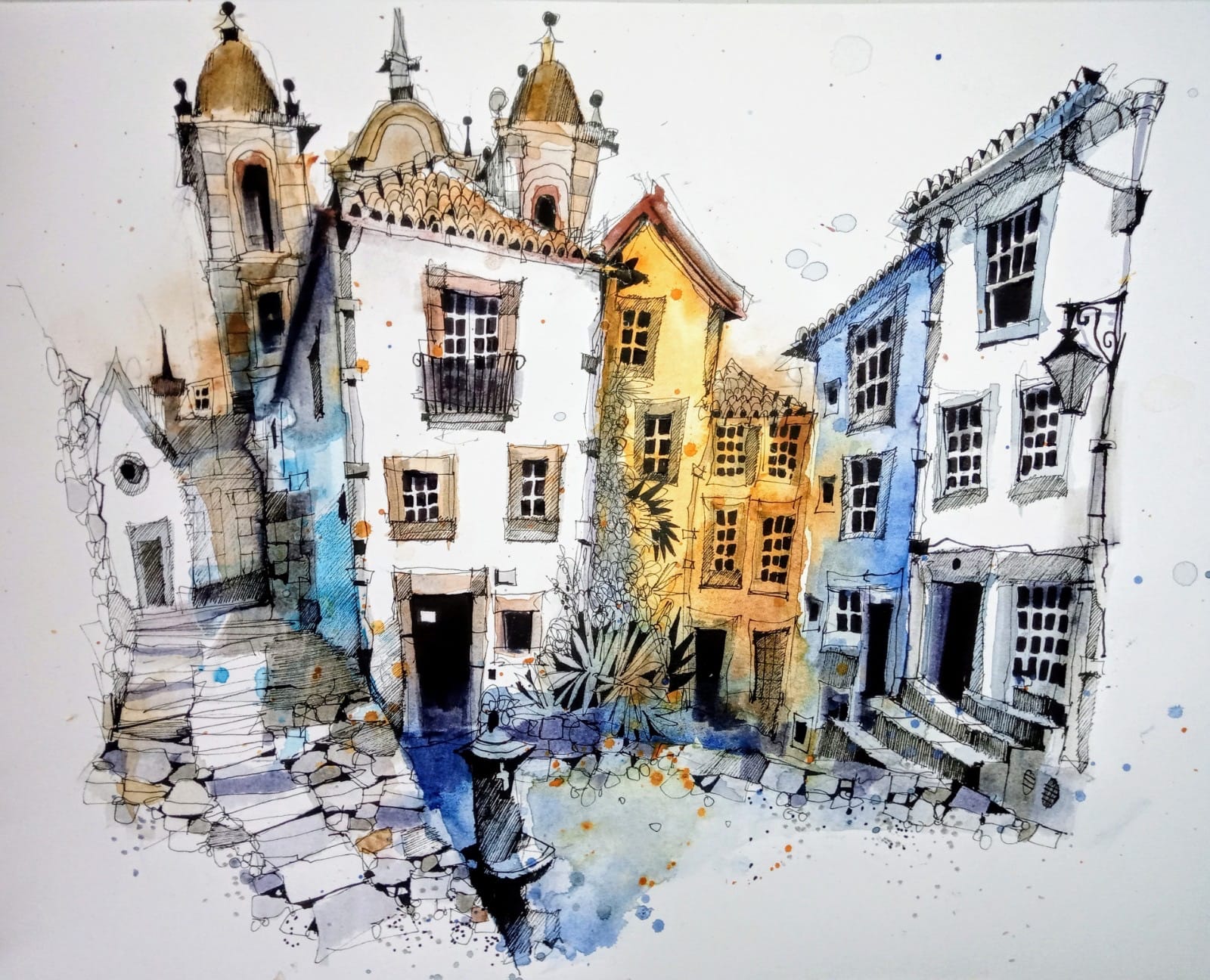
Ian Fennelly focuses on capturing urban spaces and environments by drawing the places where people have been without actually including them.
His process involves layering watercolors, brush pens, and liners to build depth, texture, and detail, allowing them to fully immerse in the scene while adapting to changes in their surroundings.
About Urban Sketch Course
- More Blog Posts -

- 13 mins
- 10 mins

- 13 mins
- 28 mins