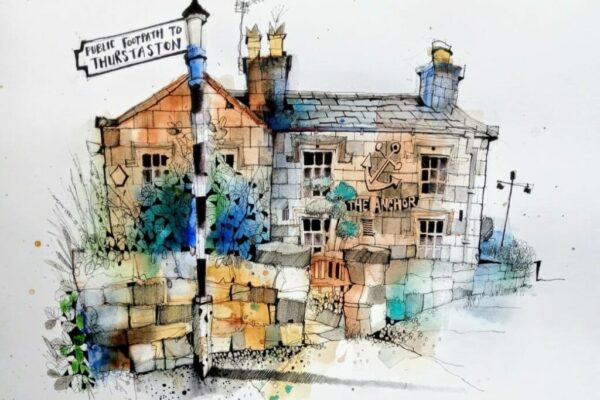
Why Buildings Are the Best Teachers for Sketchers
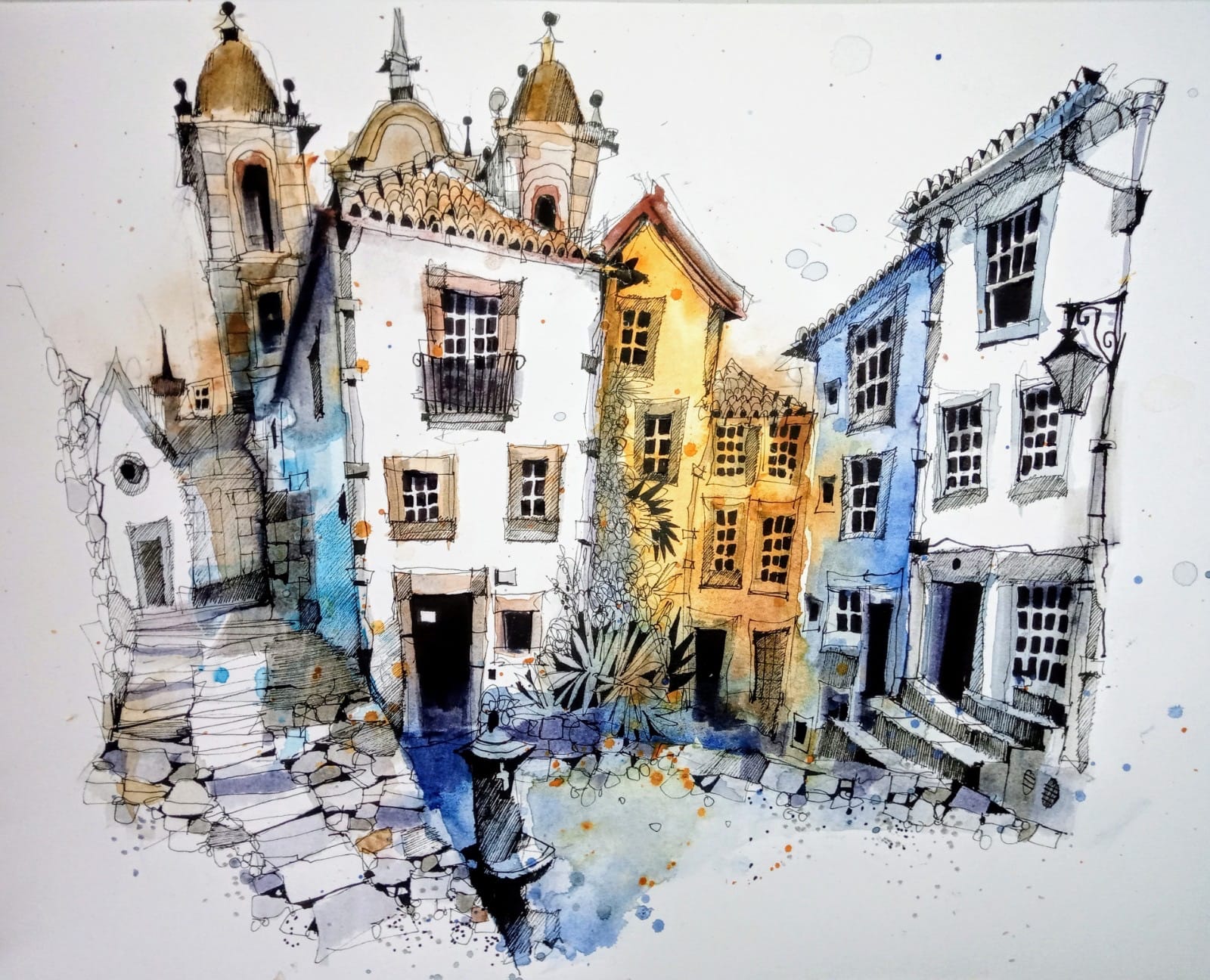
There’s something quietly brilliant about a building that’s slightly off-kilter. A sagging rooftop, a slanted window frame, that odd little patch where the bricks don’t quite match. Most of us walk past these features every day, but the moment you sit down with your sketchbook, they start whispering: “Draw me.” And here’s the thing – those buildings aren’t just passive scenery. They’re brilliant teachers. Reliable, generous, full of character. When it comes to enhancing your observation skills, your line confidence, and your storytelling instincts, nothing beats sketching a structure that’s right in front of you.
You don’t need a museum ticket or a dramatic skyline. A lamppost, a bungalow, even a crooked shed will do. Because sketching buildings gives you repeated forms, strong shapes, and built-in stories – making them perfect for practice. In many of Ian Fennelly’s courses – whether it’s sketching a high street, a quiet back alley, or a sunlit square in Barcelona – the focus often starts with buildings. Not because they’re simple, but because they teach you to look. Whether it’s a row of shops or a distant hillside town, these structures help you slow down and really notice the shapes, shadows, and stories waiting to be sketched. Every brick, balcony, and bin tells you something about structure, light, and life. The lines make sense. The patterns repeat. You begin to see the rhythm of the world around you – and more importantly, you start seeing your response to it.

How Observation Becomes Second Nature
Observation isn’t about fancy art theory. It’s about noticing. And buildings demand it. That shadow under the gutter? That odd tilt in the chimney? That patch where paint has peeled into a shape you’d never think to invent? These are the quiet details that reward attention – and make your sketches feel alive. Ian often says, “The more you look, the more you see.” It’s true – and buildings keep giving. Their stability allows your mind to relax. You can study, simplify, and stylise without the thing you’re sketching running away or blowing off in the breeze.
And the more regularly you sketch, the more this way of seeing – slower, sharper, more deliberate – starts to bleed into everything. You’ll notice how light hits the curtains in your lounge, or how the postbox outside leans ever so slightly. It’s not about mindfulness in a big, philosophical sense. It’s just the quiet habit of paying more attention. And that’s enough.
When you’re drawing a doorway, you can’t also be worrying about your to-do list. Your mind gets absorbed in the curve of the arch, the shade on the threshold, the rhythm of the bricks. That kind of focus is calming. And it stays with you. You start to notice more in daily life – not just in sketching. That’s a quiet kind of joy.

Building Confidence One Brick at a Time
Here’s a funny thing: the more you sketch buildings, the more your hand starts to act like it knows what it’s doing. Repetition does that. Those rows of windows and bricks? They build confidence. You begin to sense when a bold line works and when a flick of tone adds more than ten minutes of fiddling ever could.
In the Sketch Barcelona course, Ian had just five minutes to sketch a narrow alleyway before lunch. No time to plan, no time to hesitate – just paper, pen, and a bit of frantic groaning from his stomach. And yet, that quick sketch ended up being packed with energy and attitude. It wasn’t perfect. But it was alive. That’s what happens when you let your hand do instead of doubt.
So here’s your challenge: grab a timer. Give yourself five minutes. Find a corner shop, a porch, even your own garage. Sketch it, start with the big shapes, and don’t stop. See what your hand knows that your brain keeps second-guessing.
Want a beginner-friendly process? Try this:
Pick something small and simple.
Start with the biggest shapes.
Zoom in on a detail.
Hold your pen loosely.
Look for repetition.
Bonus tip: if you’re using a brush pen, let it do the heavy lifting for tones and shadows. One quick swoosh and you’ve got drama!

Getting Perspective - Without Getting Technical
Let’s be honest – no one wants to go back to school just to understand vanishing points. But sketching buildings helps you pick up perspective by doing, not diagramming. When you draw a terrace, for example, you start to feel how lines pull towards a vanishing point. You don’t have to name it, measure it, or explain it – you see it. And then you start using it.
What Ian does so well is exaggerate perspective. Let a shopfront tilt towards you. Stretch that doorway a little. Lean that lamppost like it’s had one too many. These aren’t mistakes – they’re expressions. They help your sketch tell a better story. If your roofline ends up a bit bent, that’s not a fail. That’s character. Let it lean.
Sketching on location adds another layer. Even if it’s just your street corner or the view from a bench in the park, you notice things you’d never see in a photo – how the shadows move, how people interact with the space, how the noise and bustle feed into your lines. Ian often sketches while chatting with passers-by or dodging gusts of wind. It adds pressure – but it also adds life. When you sketch on location, you’re not just drawing – you’re being there.

Every Building Tells a Story
Take that tired bus stop near your local post office. The one with the graffiti, the battered bench, and the sticker half-peeled off the timetable. That’s a scene. That’s life. Sketch it, and suddenly you’re not just drawing lines – you’re capturing something that most people overlook.
One of our community members Kathy shared a sketch made from a photo she’d taken through a bus window while travelling the Amalfi Coast. She said that during those long, non-travel years, she’d started working her way through old travel photos, journaling them into sketchbooks. And something wonderful kept happening – each time she sketched, she felt transported. Right back to the event. Right back to the feeling. That’s the thing: our sketches don’t just show what we saw – they reconnect us with where we’ve been and who we were when we saw it. Even buildings hold time in their walls. And when we sketch them, we’re not just documenting – we’re remembering, re-entering, and adding our layer to the story.
This is storytelling through sketching – not made-up stories, but real ones. Ordinary places that say something about who we are, how we live, and what we remember. That’s what makes them worth sketching.

The Power of Sharing Imperfect Work
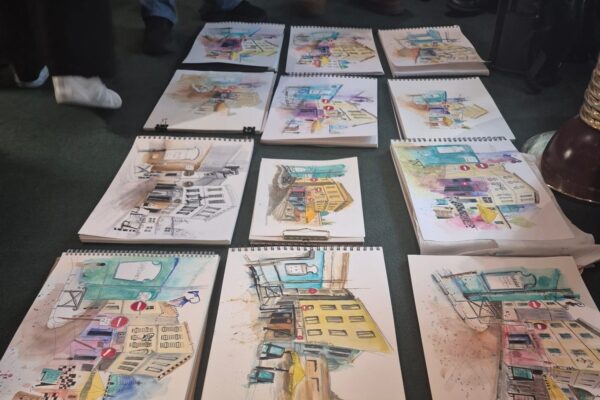
Urban sketching isn’t a solitary sport. Sure, we might sit alone on a bench sometimes, but we’re part of a global community that cheers each other on. There’s real power in sharing your sketch – even if it feels unfinished or a bit off. Because someone else will look at your crooked lines and see courage. They’ll see their own doubts in your brush marks. And they’ll thank you for reminding them that perfection isn’t the point.
One of our community members Suzanne recently shared her sketch of the Laurel Inn in Robin Hood’s Bay. She admitted it was a real challenge – she hadn’t picked up a pen in a month, and the building’s many different perspectives made it tough going. But she stuck with it. She said, “I can see it’s not right, but I think that’s okay at this point. I took it on knowing it would make me work hard.” That kind of honesty? It resonates. The comments rolled in – not because the sketch was perfect, but because it was brave, thoughtful, and real. That’s the beauty of sharing work in progress – it reminds all of us that effort, not polish, is where growth lives.
One person’s wonky lamppost is another’s reminder that it’s okay to be messy. This is how we learn. Not by hiding our rough edges, but by sharing them.

Final Word: Keep Going, Keep Noticing
So here’s the real takeaway: buildings aren’t just something to sketch. They’re something to learn from. They sharpen your eye. They train your hand. They open up your ability to tell stories, notice life, and feel more connected to your surroundings.
Next time you pass that garage with the dodgy door and the leaning fence, give it a nod. It might just be your next breakthrough. You don’t need fancy materials or epic landscapes. Just a pen, a little time, and something solid to draw. Your sketchbook will thank you. And so will your confidence.
Ready to learn more?
Join Ian Fennelly in Sketch Barcelona – a full urban sketching adventure where you’ll explore bold brushwork, loose lines, and lively compositions across the streets and scenes of Spain’s most inspiring city. With on-location demos, timed challenges, and practical lessons that get you sketching fast, it’s a brilliant way to grow your confidence and reconnect with the joy of observation.