
Why the Prettiest Building Isn’t Always the Best One to Sketch
- Blog
- October 6, 2026
- 22 mins
Barley Hall in York is a restored medieval townhouse, with beams, a little courtyard and cobbles, and it’s been looked after beautifully. Ian stood in that courtyard and explained why he wasn’t going to sketch it.
His reason is worth borrowing.
"It's kind of too pristine, it's too well preserved, because it has been restored, probably restored in the last 10 years. So visually it looks really interesting, and it's one of those places that if you're on holiday you go and look at these things and they look fantastic, but they're not great to sketch because there's no story really. The story happened a long time ago."
– Ian Fennelly
Then he sums it up: it’s become “an illustration of an idea of something that happened a long time ago.”
A pretty building shows you what it looked like. A building with a story shows you what happened to it.

Where the story lives
That’s the difference this whole post is about, and it’s the part a sketch is best at. Here’s where to look for it.
Look at the bottom of the walls. On another building in York, Ian stops on the low courses: “I like how these bricks at the bottom are just like a little bit broken off, just starting to disintegrate a little bit.” That’s rain and frost and boots and carts, all in one row of bricks.
Look at the ironwork. He’s delighted by a set of brackets on one of his sketches: “I do love these iron brackets, these kind of curly brackets, they’re just so brilliant, and they don’t do them anymore.” Somebody made those for one wall, a long time ago, and they’re still holding something up.
Look at the doorstep. A step that’s been walked on for a couple of hundred years dips in the middle. You can draw that dip in three lines, and anyone who sees your sketch will know how many feet have gone through that door.
On a pretty building, all of that’s been tidied away. That’s what Ian means when he says there’s no story.

"Too historic" sounds odd, but it isn't
How can a building be too historic to draw?
Ian’s answer is that the history has been put in the past tense. Barley Hall is about something that happened. A building with a story is still carrying it.
You can hear it in how he talks about the ones he does choose. One has “that kind of old, beaten quality to it, which has just seen so much amazing history.” Another gets: “the amount of history this thing must have seen, must have witnessed, I’m sure some of it was pretty gruesome as well.”
Seen. Witnessed. He talks about those buildings as if they were there when it all happened, and they were. Your sketch can show that.

Look for today, as well as yesterday
There’s one more thing Ian says in that courtyard that’s easy to miss. Straight after “no story really”, he says what he goes for instead:
“I like views as you know, which has got lots of kind of street furniture things that you can relate to today.”
Street furniture is all the everyday clutter a postcard leaves out. Bollards. A parking sign. A bin. Cables strung between two chimneys. A bike chained to the railings. A chalkboard outside the café.
It sounds like the opposite of history, but it’s what makes the history readable. An old wall on its own could be from any time at all. Put a parking sign in front of it and you can suddenly see how old the wall is, because you’ve got something from today to measure it against.
A pretty, restored courtyard tends to have all of that cleared away as well, so there’s nothing from today to set the old against.
Ian does exactly this with signs. In Shrewsbury, he puts a little pavement board into his sketch of an old wine merchant’s, because “it’s telling you about today.” We’ve written more about that in How to Draw Signs and Lettering in Your Urban Sketches.
So when you’re choosing, look for what’s old with something from today sitting right next to it. That’s where the story is.
The two buildings on your own street
You don’t need a medieval city for this. Walk to the end of your road and you’ll probably find two old buildings, or two old somethings.
One’s been done up. New render, new windows in the old openings, a paint colour chosen from a chart, the drainpipe boxed in.
The other has a gutter held on with a bracket somebody clearly made themselves. A front door that’s been painted about six times, and you can see all six at the edges. A bricked-up window nobody’s ever explained. An old shop name showing faintly through the paint, above a door that sells something else now.
You already know which one you want to draw. Most people do, before they can say why.
Here’s why. Every one of those marks on the second building is a little bit of story, and a sketch is good at carrying that, because drawing is a slow way of looking. Slow looking is how you notice a bracket somebody made by hand.
What to look for
When you’re deciding whether something’s worth sitting down for, run through this list.
- Has anything been repaired in a hurry? A patch of the wrong brick. Render that stops halfway. Two kinds of tile on one roof. Repairs are evidence of somebody deciding, and they’re often more interesting than the original.
- Is there anything nobody would add now? Boot scrapers, a faded advert painted on a gable end, a name carved over a door, a cellar hatch in the pavement.
- Is there anything nobody would have added then? A satellite dish on a building older than electricity. A wheelie bin in a doorway built for a horse. They’re funny, they’re true, and they’re what make a sketch look like today and not like a costume drama.
- Has anything been worn down by use? A dipped step, a handrail polished by hands, a kick plate scuffed back to bare metal.
- Can you see more than one decade at once? That’s the test. If you can, draw it.
Draw the story first
Here’s the part that changes the sketch itself.
Most of us draw the building and add the character at the end, if there’s time. There’s never time, so the character gets left off, and you end up with a tidy version of the very building you picked because it wasn’t tidy.
Turn it round. Draw the story bits first: the patched brick, the bracket, the worn step, the old sign. Get them down while your hand’s fresh and your pen’s loose, then fit the rest of the building around them.
That way, the sketch ends up being about the thing that made you stop.
If the pretty one is all there is
Plenty of pretty buildings are a pleasure to sit in front of. If one of them’s in front of you and you’ve got an afternoon, draw it. Ian says the same about Barley Hall: “by all means have a go at it, you can really play around with it.”
But if you’ve got two buildings to choose from, pick the one that shows its age. It’ll give you more to draw.
Once you’ve heard Ian explain it, you’ll start walking past the postcard building too.
Ready to learn more?
Want to hear Ian explain it himself? Watch him in the courtyard at Barley Hall, talking through why it’s not one for his sketchbook:
Why the Prettiest Building Isn’t Always the Best One to Sketch

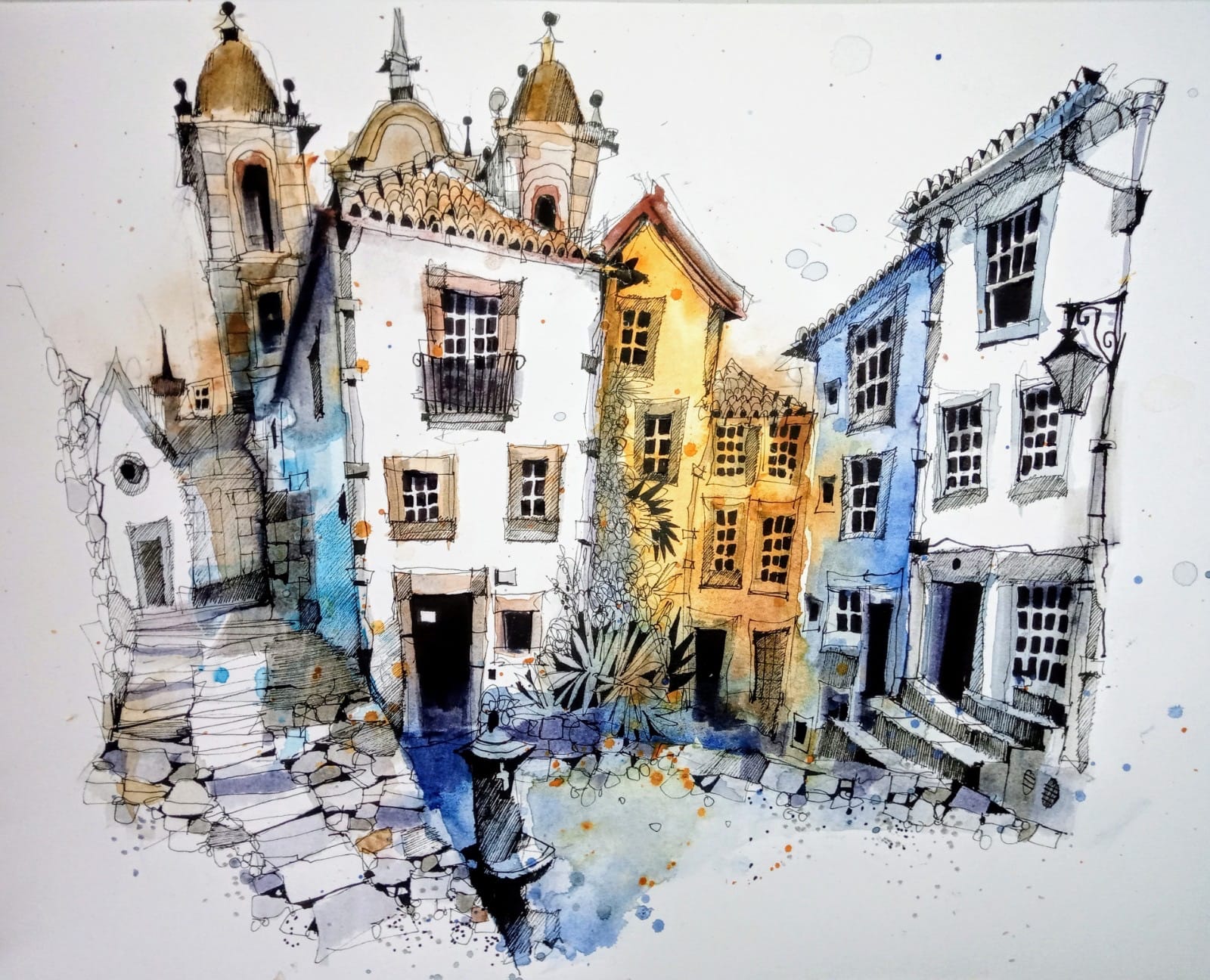

About the Artist
Ian Fennelly focuses on capturing urban spaces and environments by drawing the places where people have been without actually including them.
His process involves layering watercolors, brush pens, and liners to build depth, texture, and detail, allowing them to fully immerse in the scene while adapting to changes in their surroundings.

About Urban Sketch Course
- More Blog Posts -

- 11 mins

- 42 mins
- 23 mins
- 28 mins