
Our 4 Week Urban Sketching Experience: What Riomaggiore Taught Us
- Blog
- September 15, 2026
- 42 mins
We knew what we were doing when we picked Riomaggiore for our Urban Sketch PLUS 4 Week Experience.
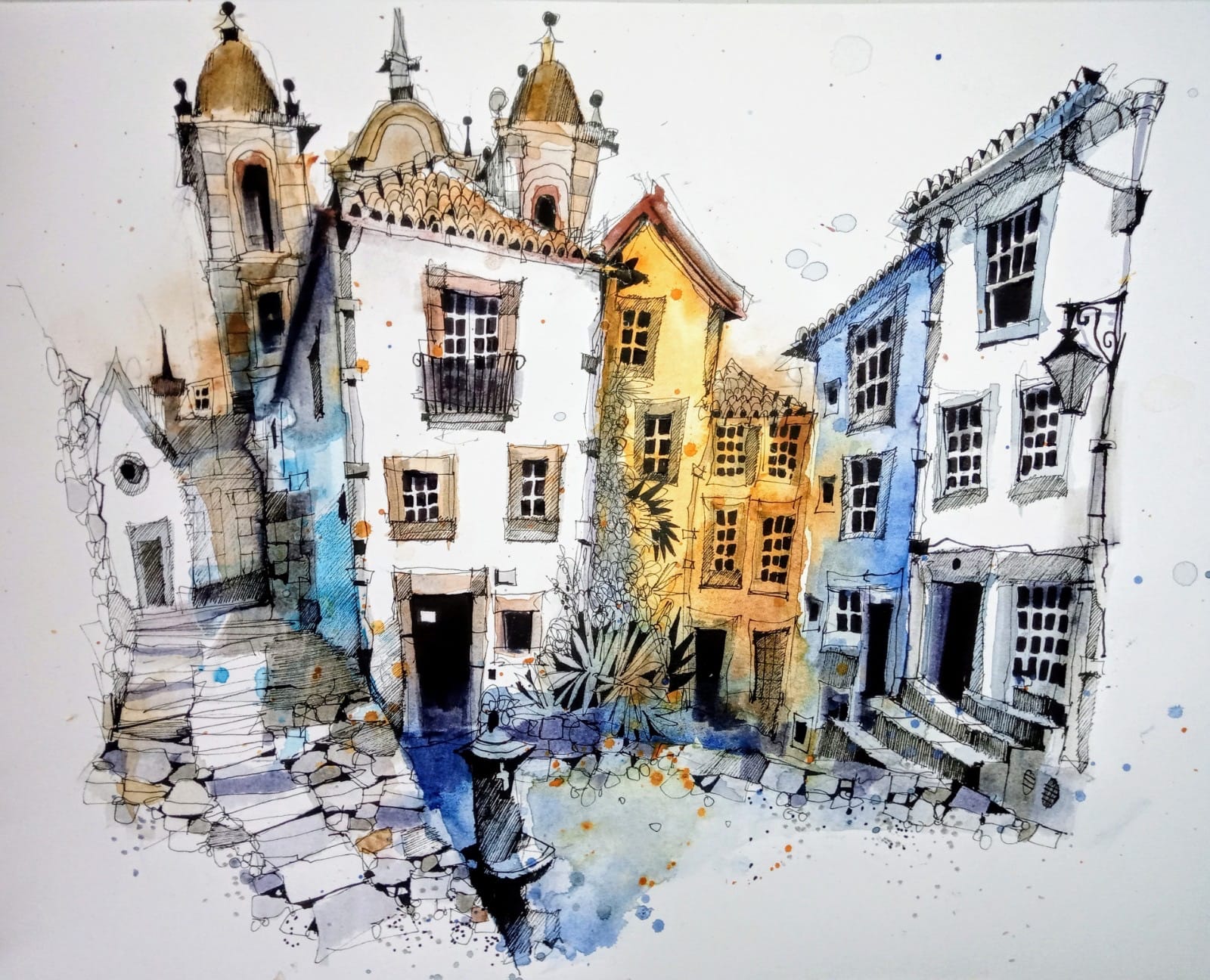
An old Italian town falling down a hillside onto the shoreline. Jumbled houses stacked on top of each other, rock formations behind, open water in front, and a slipway with an arch tucked underneath it. Three completely different kinds of subject in one view, and somewhere around forty buildings in the middle of it.

Ian said it in week one and kept saying it right through to week four. This is hard. Not hard by accident, hard on purpose, because that is where the learning is. He also pointed out, more than once, that it is hard for him too, and he has been doing this all his life.
Four weeks on, the same handful of lessons had come back to us over and over, in the critiques, in the comments, and on the celebration call at the end. Here they are.
It isn't detail. It's information.
The first real shift happened in week one, and it caught a lot of people out, because the question everybody arrives with is some version of “how much should I be putting in at this stage?”
The answer turns out to depend on what you think you are putting in.
When Tricia C’s outline came up in the critique, her windows were all more or less the same. Neat, even, correct. Ian’s suggestion was to vary them: double up a frame here, drop a lintel in there, put a little arch above a doorway, shrink them as they climb the hill until they are barely dots. She asked whether that meant putting the detail in earlier than planned, and he stopped her.
It's not detail, it's information.
– Ian Fennelly

That distinction did a lot of work over the following weeks.
Detail is the last stage, and it stays there. Information is anything you put down that tells you something useful later: a ripple line in the water so you know where to push the pigment, a suggestion of a balcony so you have something to build on, a few pops of black so you don’t lose a dark archway under the paint.
Lynne M, arrived at the same place by a different route. She tried to follow Ian’s outline building by building, watched it live, watched the recording again, and finally accepted that she could not possibly copy them all. So she started making them up instead.
That’s not giving up. That’s editing the scene.
The painting stage is the middle, not the end
This was the single biggest idea of the four weeks, and it caught out experienced painters more than beginners.
You spend two weeks on a drawing you are proud of, and then somebody asks you to put paint on top of it. Ian knows precisely what happens in people’s heads at that point, because he hears it every time: the voice that says you are about to ruin it.
The fix isn’t confidence. It’s understanding what that stage is actually for.

Most people paint at the beginning or at the end. Here it lands in the middle, with two more weeks of drawing still to come, and that changes what the paint is being asked to do. It isn’t resolving the picture. It is laying down colour for the brush pens and fineliners to work on top of.
It's not its turn to be fixed with paint.
– Ian Fennelly
He says it about his own sketch, mid demonstration, pointing at whole areas of the background he has deliberately left alone. Not because he ran out of time. Because it is not that stage’s job.
Julie put the contrast beautifully. She comes from botanical art, where you work with very precise brushes and the painting solves everything. This is a step in the opposite direction, and she said she was loving it.

Susan L, who hadn’t touched art since school, summed it up in one line when her work came up. She was disappointed with her painting and said so plainly. But she also said she understood that this is the ugly stage.
That is the shift. Not liking it yet, and carrying on regardless. Gilli put the same realisation another way in the chat: she had to learn not to finish the picture with paint. Soft washes, not fiddly painting.
And Lina, who has sketched with Ian on location plenty of times, gave the group the version that probably lands best:
You have to learn to trust the process and not panic if something isn't exactly right, because you have more chances to improve upon it as each step goes by. So you don't have to be afraid.
– Student Lina
Water Is The Control, Not More Paint
The most common practical problem across the whole four weeks was work going muddy or heavy. The instinct when that happens is to add something: more pigment, another layer, a correction.
Ian’s answer is the opposite. Stop adding pigment, add water, and push what is already there around with it. Slowly, with a flat brush, using the weight of the brush rather than any pressure. A lot of pigment goes down early in his process, quite dark, and then it gets moved around the paper gently over several minutes.
That is where the softness comes from.
Two habits worth stealing. He pulls water off the brush with his other hand before it touches the paper, constantly and instinctively, so the brush carries exactly as much as he wants.
And if something dries too dark, it can usually come off: wet it gently, let the water sit, then lift with a paper towel. Opaque colours lift almost completely. Transparent ones stain, so they fight back.
There is also something he never does, which surprised a few people. He doesn’t wet the paper first. If someone tells you to, he says, ask them why, because you won’t get a good answer. It is going to get wet anyway, and this way you wet only the parts you want wet and keep the hard edges you would otherwise lose.
All of that serves one idea, which came out when a member asked what he means by “opening up” an area. He is constantly switching between painting a shape and painting space.
A shape is a defined form: the flat elevation of the main building with its rows of windows. Space is colour running across several things at once, the quayside sliding down into the water, or the buildings and wall and archway off to the right all blending together. Shapes alone come out flat. Space alone comes out as a mess where nothing reads.
You need both, and moving between them is also, as he put it, a good deal more fun than grinding through shape after shape until your head explodes.

We are not teaching you a style
This one surprised people, and it changes what you think you are being measured against.
During one of the critiques Ian put two students’ work up one after the other. Dominic R’s was tight and structured, heavily modelled, real weight in the shadows.
Donna W’s was loose and vivid, wet on wet, colours running wherever they liked.
Completely different pictures from the same reference photo, and he was clear that both were entirely right.
We are not teaching style. It's about all the underlying principles
– Ian Fennelly
What is being taught is layering, blending, where to paint and where to leave alone, choice and balance of colour, and how tone builds depth. What you do with those is yours. One Ian Fennelly, as he put it, is enough.
Marlies A had worked this out for herself and built her whole four weeks around it. She deliberately set out not to copy what Ian was doing, which on a scene this complicated meant taking on a second challenge alongside the first. Her version is unmistakably hers.
Carolyn N came at it from another direction. She was an art major, then spent forty years in education, and picked up a brush again in retirement. What drew her to Ian’s work was the wonkiness, and what she loves is taking a line for a walk. Her buildings lean. The windows read like eyes, some wide open, some half shut.
And Ian himself doesn’t think his own version is settled either. At the end of the final session he looked at his finished sketch and said that next time he would shift the whole composition over, compress the town a little and let the rocks and landscape stretch out further. He also admitted it came out darker than he expected. So if you finished yours and immediately saw everything you would change, so did he.
Unlearning precision
The hardest version of all this is when your working life trained you the other way.
I'm a retired accountant. I thrive on precision (almost engineer like), but I find I can sketch better when I throw that precision out the window
– Student Janet D
A civil engineer in the chat replied that his mind works in exactly the same way. Someone else said the loose style is the thing she likes most about it, precisely because it is freeing.
That is worth saying, because a lot of people arrive assuming that being careful is the skill. On this scene it is the opposite. Getting every window in the right place would have taken a fortnight and produced something worse.
You learn as much from someone else's critique as your own
This came up again and again on the final call, and it is the thing most people underestimate about turning up live.
Jo H picked up a paintbrush for the first time at the beginning of June and Riomaggiore was her tenth ever sketch. She reckoned she took four or five things from every session, and said she had learned more from four weeks of critiques than from a year of working it out alone.
Tricia said much the same: sketching at home you are doing it in a vacuum in your room, and hearing someone else say “I struggled with this, here’s what fixed it” is what makes the difference.

Marlies gave the clearest example. Ian had told another student not to push the Tombows too dark in one particular area. She was unsure about exactly that spot on her own sketch, took advice that had been aimed at somebody else, and left it alone.
It is now one of the strongest parts of her finished piece.
Nobody’s work gets pulled apart in these sessions. When submissions come in, the common themes get picked out and five sketches are chosen that between them cover the questions most people are quietly having.
So even when your own work is not on screen, the answer to your problem usually is.

Look for the small things
Week four opened with the walk into the scene, where Ian talked through what actually catches his eye. It wasn’t the obvious stuff.
Yes, there are the terraces, the railings, the washing on the line, the shutters, the boats on the slipway, the roofs shrinking as they climb. But what he singled out were the weeds growing out of the wall, the cracks in the rock, and a small red rubber ring hanging on the railings by the steps.
They're the things that you normally miss if you don't stop and look
– Ian Fennelly
That is the argument for staying with one subject for a month. You are forced to keep looking, and once your eye is tuned to notice a weed in a wall it does not stop when you move on to the next scene.
The best summary of what that does to you came from Gina D at the end of week four. She has actually sat on those rocks in Riomaggiore.
She had never once looked at them with that much intent, and she thanked Ian for making her see them.
And then what happens to it
The nicest part of the final call had nothing to do with technique.
Jo’s husband has claimed hers. He is framing it for the room where he watches his sport, which she is delighted about, given how many hours of painting he has put up with.
Dominic is giving his to his eldest daughter, who married during Covid and had to cancel an Italian honeymoon. They are hoping to go next year.

Carolyn N calls herself a closet painter, because that is generally where her work goes. This one might go to her nephew, who was on the family trip to Riomaggiore with her.
Nancy C planned to keep hers in the sketchbook and look at it now and then, and was told in no uncertain terms to frame it and get it on a wall.
Marlies said she would love to exhibit one day but is too scared. Then she pointed out that she has already come a long way, because when she started this she was scared of everything.

One arrived by email after it was all over.
Sylvia W’s has been given pride of place on the wine shelf in A Tavola, propped between the glasses and the Italian reds.
Italy has mattered to her since her first trip as a mature student around 1980. She is still in touch with the family she stayed with, and she has been going back and learning the language ever since.
That is what four weeks on one hard scene actually produces. Not just a better sketch. Something a family wants on the wall, something a shop wants on its shelf, and somebody a bit braver about being seen

And one last thought, from Carolyn N’s conversation with Ian. There is an enormous amount of computer-generated imagery out there now, and a great deal of it you cannot tell from the real thing.
What you made over these four weeks is not that. It is paper, water, pigment, a pen, and a person deciding what mattered.
Ready to learn more?
None of this is a one-off. The same way of teaching runs all year inside Urban Sketch PLUS: critiques every month on work members send in, new training every two weeks in the same bite-sized stages, a monthly live call where you can ask Ian anything, and a media library of past webinars, and workshops.
Our 4 Week Urban Sketching Experience: What Riomaggiore Taught Us

About the Artist
Ian Fennelly focuses on capturing urban spaces and environments by drawing the places where people have been without actually including them.
His process involves layering watercolors, brush pens, and liners to build depth, texture, and detail, allowing them to fully immerse in the scene while adapting to changes in their surroundings.
About Urban Sketch Course
- More Blog Posts -

- 11 mins

- 10 mins
- 15 mins

- 30 mins