
Why Old Pubs Are the Perfect Thing to Sketch
Especially If You Think You Can't Draw
- Blog
- March 14, 2026
- 40 mins
Why Old Pubs Are the Perfect Thing to Sketch (Especially If You Think You Can't Draw)
There is something about a 400-year-old pub that wants to be drawn.
Picture this for a moment.
You’re sitting on a bench across from a pub that has been standing since before your country existed. The timber frame sags in the middle like a man who has had one too many. The windows are not quite square. The door is not quite centred. A hanging basket droops over a chalkboard advertising pie and mash, and somewhere above the entrance a carved sign has been telling the same story for three hundred years.
You have a sketchbook open on your lap. A pen in your hand. And you are thinking: Where on earth do I start?
Here is the beautiful secret that urban sketchers discover about old pubs, and that most people never guess: they are one of the easiest, most forgiving, most deeply satisfying things you will ever put a pen to.
Not despite the wonkiness. Because of it.

The Flat Facade Trick (Or: Why Pubs Solve Your Biggest Problem)
If you have ever tried to sketch a building and felt the whole thing collapsing into a confusing mess of angles, you are not alone. Perspective is the thing that stops more beginning sketchers in their tracks than anything else. The moment a building turns a corner, or recedes into the distance, or has multiple rooflines at different angles, the mental gymnastics begin — and the joy drains out.
Old pubs, particularly the kind you find tucked into English villages and Irish market towns, offer you something quietly miraculous: a flat front face looking straight at you.
Ian Fennelly, who has sketched dozens of pubs across the UK and beyond, puts it this way:
The front facade almost acts as your general structure, your blank page almost, and then within that page you can start populating it with loads and loads of detail.
– Ian Fennelly
Think about what that means. Instead of wrestling with vanishing points and converging lines, you are essentially drawing a rectangle. A big, friendly, flat rectangle that sits there patiently while you fill it with all the beautiful chaos that makes an old pub an old pub.
As Ian puts it when sketching the Plasterers Arms: “The front elevation of the pub is just your excuse for being creative.”
Your excuse for being creative. Not your test. Not your exam. Your excuse.
That flat facade is a gift. It takes the single most intimidating technical challenge off the table and replaces it with an invitation: here is your canvas. Now play.

Why Imperfection Is the Whole Point
Here is something that might change the way you think about drawing.
When you sketch a modern glass office building, every line needs to be straight and every proportion needs to be precise, because the real building is straight and precise. Any wobble in your pen reads as a mistake.
But an old pub? An old pub has been wobbling for centuries. The beams have warped. The plaster has cracked. The roofline dips where the weight of four hundred winters has pressed it down. The windows are different sizes because they were fitted by different hands in different decades — or different centuries.
Your wobbly line is not a mistake. It is accurate.
This is not a small thing. For anyone who has ever put down a pen in frustration because their lines were not straight enough, old pubs are a revelation. The imperfections are not problems to solve. They are the beauty. They are exactly what makes the sketch come alive. A perfectly straight line on a Tudor pub would be the lie. Your shaky, human, slightly uncertain pen stroke tells the truth.
The crooked beam. The warped glass catching the light at an odd angle. The patch of render that fell off decades ago and was never quite repaired. The door frame that leans two degrees to the left. These are not bugs. They are features. Every single one of them is a gift to the sketcher, because every single one of them gives your drawing character without you having to manufacture it.

The Playground Method: Structure First, Then Freedom
There is a way of approaching these sketches that turns the whole experience from stressful to joyful, and it comes down to two stages.
First, you establish the basic structure. The outline of the facade. The main divisions — where the door is, where the windows sit, where the roofline begins. Simple shapes. Big decisions made early and confidently, even if they are not perfect.
Then, something shifts.
Ian describes it like this:
Step one and step two are almost like trying to create a playground for yourself, and now I'm going to go into that playground and I'm going to play.
– Ian Fennelly
A playground. Not an exam hall. Not a test of your abilities. A space you have built for yourself where you now get to explore, experiment, and discover.
And this is where the real magic begins. Once the basic structure is down, the process moves from observation to expression. In Ian’s words: “It’s been very much about observation and the eye. Now it’s about the heart.”
The eye gives you the structure. The heart gives you the sketch.

Looking Deeper and Deeper
One of the remarkable things about old pubs as subjects is that they reward attention like almost nothing else. The more you look, the more you see.
“You start off with a very, very simple structure, a front elevation,” Ian explains, “and then you start looking deeper and deeper and deeper into that subject and you start noticing things and you start seeing things.”
This is the experience that sketchers talk about and non-sketchers rarely understand. The act of drawing a place forces you to truly see it in a way that photography never does. When you photograph a pub, you capture it in a fraction of a second. When you sketch it, you spend an hour in conversation with it.
And old pubs have so much to say.

The details are everywhere, and they are the kind of details that tell human stories. Ian notices “all the kind of references to the people and the things that we might bring along them — dog bowls, signage, satellite dishes, hanging baskets, sandwich boards outside with special offers.”
A dog bowl by the door. Think about what that tells you. Somebody who runs this pub cares enough about the locals and their dogs to put a bowl of water out front. That is a story. That is a community. That is a life being lived, and it is sitting right there at your feet, waiting to be drawn.
The sandwich board with its daily specials written in chalk. The faded brewery sign that nobody has updated since the 1980s. The satellite dish bolted awkwardly onto a building that predates electricity by two hundred years. The way the ivy has been allowed to creep halfway across the upper storey but has been firmly trimmed back from the entrance.
Every one of these details is a sentence in the story of a place. And when you sketch them, you are not just recording what you see. You are becoming the storyteller.

Colour as Imagination, Not Copying
I'm not copying the Plasterers Arms exactly. I am making a piece of art based on what I can see, and in order to do that I use my imagination.
– Ian Fennelly
Here is something that surprises people who are new to urban sketching: you do not have to match the colours exactly.
Read that again. I use my imagination.
This is the moment where sketching stops being a technical exercise and becomes a creative act. The pub in front of you is your inspiration, not your boss. If the beams are dark brown but your gut says they should be a deep violet mixed with burnt sienna, then that is what they should be. You are making a piece of art. You are expressing your experience of being in that place at that moment, not producing an architectural survey.
For beginners, this is enormously liberating. You do not need to own thirty-seven precisely matched paint colours. You do not need to agonise over whether your green is the right green. You need a few colours you love, and the permission to use them as your heart dictates.
The old pub does not care. It has been standing there for centuries. It has survived wars and recessions and the smoking ban. It can certainly survive being rendered in Windsor Violet.

Why This Works for People Everywhere
If you are reading this from Texas or Toronto or Tasmania, you might be thinking: This sounds wonderful, but there are no 400-year-old pubs where I live.
And that is precisely part of the magic.
For the millions of sketchers around the world who did not grow up in the UK or Ireland, old British and Irish pubs carry a kind of storybook romance that is hard to find anywhere else. These are buildings that were serving ale when Shakespeare was writing plays.
The Wheatsheaf, one of the pubs Ian sketches in his Pub Sketching Course, was built in 1611. As Ian puts it with characteristic wonder: “This place was built in 1611, so it’s been serving Heineken and Carlsberg since 1611. Just amazing.”
There is something almost mythical about that. A building that has been doing the same thing, in the same spot, for over four hundred years. The idea of sitting across from it with a sketchbook and capturing it in your own hand — it’s not just an art exercise. It’s also a form of time travel.
And here’s the thing: you do not need to be there in person to begin. The principles that make old pubs perfect subjects — the flat facade, the forgiving imperfections, the layers of human detail, the freedom to play with colour — these apply to old buildings everywhere. The weathered general store in a New England village. The crumbling shopfront in a Provençal market town. The corrugated-iron pub in outback Australia with its tin roof and flyscreen door.
Old buildings that have been shaped by time and use are forgiving subjects wherever you find them. But there is something about an English pub, with its hanging baskets and its crooked beams and its hand-painted sign swinging in the rain, that makes the heart of a sketcher beat a little faster.
What It Actually Feels Like
Let’s paint you a picture that has nothing to do with paint.
It is a Thursday afternoon. You are sitting on a low wall across from a pub you found by accident while walking through a village you had never heard of until this morning. The pub is called something like The Crown or The Red Lion or The Old Bell, because they are always called something like that.
The sun is coming in at an angle that makes the upper windows glow. There is a dog tied up outside, waiting patiently. Someone has left a bicycle leaning against the wall. The hanging baskets are a bit past their best, but the trailing flowers still catch the light.
You have your sketchbook open. You drew the basic shape of the facade ten minutes ago — just a rectangle, really, with a couple of lines to mark where the door and windows sit. And now you are in the playground. You are adding the crooked beam that runs across the first floor. The sign with its gold lettering. The drainpipe that has gone slightly green with age. The small window that is a completely different style from all the others, because someone added it in 1790 and nobody ever bothered to make it match.
You are not thinking about perspective. You are not worrying about whether your lines are straight. You are looking at this beautiful, battered, ancient thing and you are seeing it — really seeing it — maybe for the first time in your life. And what you are putting on the page is not a perfect reproduction. It is your version. Your story. Your afternoon, captured in ink and colour.
That is what it feels like to sketch an old pub. It feels like falling in love with a place you have known for an hour.

If you have been wanting to sketch but have not started because you are afraid of perspective, or afraid your lines will be wobbly, or afraid you do not have enough talent — find an old building. The older the better. The more crooked, the more crumbling, the more patched and repaired and weathered by time, the better.
Sit down in front of it. Draw the big shape first. Just the outline. Do not overthink it.
Then go into the playground. Start noticing the details. The things that make this building different from every other building in the world. The dog bowl. The chalk sign. The window that does not match. Draw them. Not perfectly. Just honestly.
You might surprise yourself.
Because old pubs — and old buildings everywhere — do not demand perfection from you. They have never been perfect themselves. What they demand is attention. And what they give you in return is a sketch that feels alive, that tells a story, and that came from your hand and your eye and your heart.
Pick up a pen. Find a wall to sit on. And see what happens.
The flat facade trick, the Playground Method, and the idea that your wobbly line is accurate — these are all from Ian’s Pub Sketching Tour, where he walks you through four real British pubs, step by step, from first mark to finished sketch.
Ready to learn more?
Ian Fennelly’s Pub Sketching tour will show you how to create lively, characterful sketches by focusing on charming pub facades, strong composition, and the small details that bring a scene to life. It is a brilliant way to build confidence, simplify the sketching process, and learn how to capture the atmosphere and story of a place in your own distinctive style.
Why Old Pubs Make Perfect Sketching Subjects

About the Artist
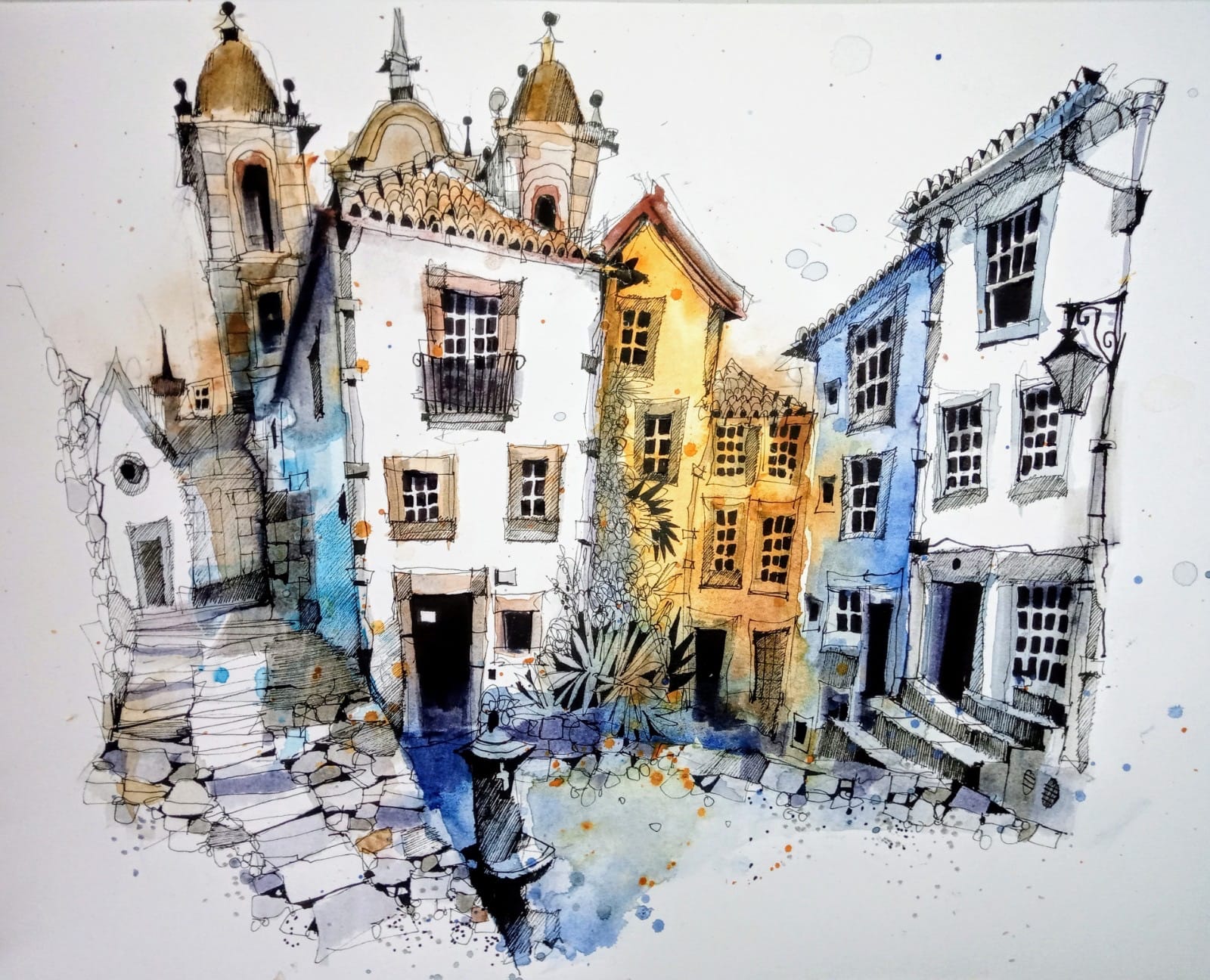
Ian Fennelly focuses on capturing urban spaces and environments by drawing the places where people have been without actually including them.
His process involves layering watercolors, brush pens, and liners to build depth, texture, and detail, allowing them to fully immerse in the scene while adapting to changes in their surroundings.
About Urban Sketch Course
- More Blog Posts -
- 26 mins
- 19 mins

- 19 mins
- 35 mins