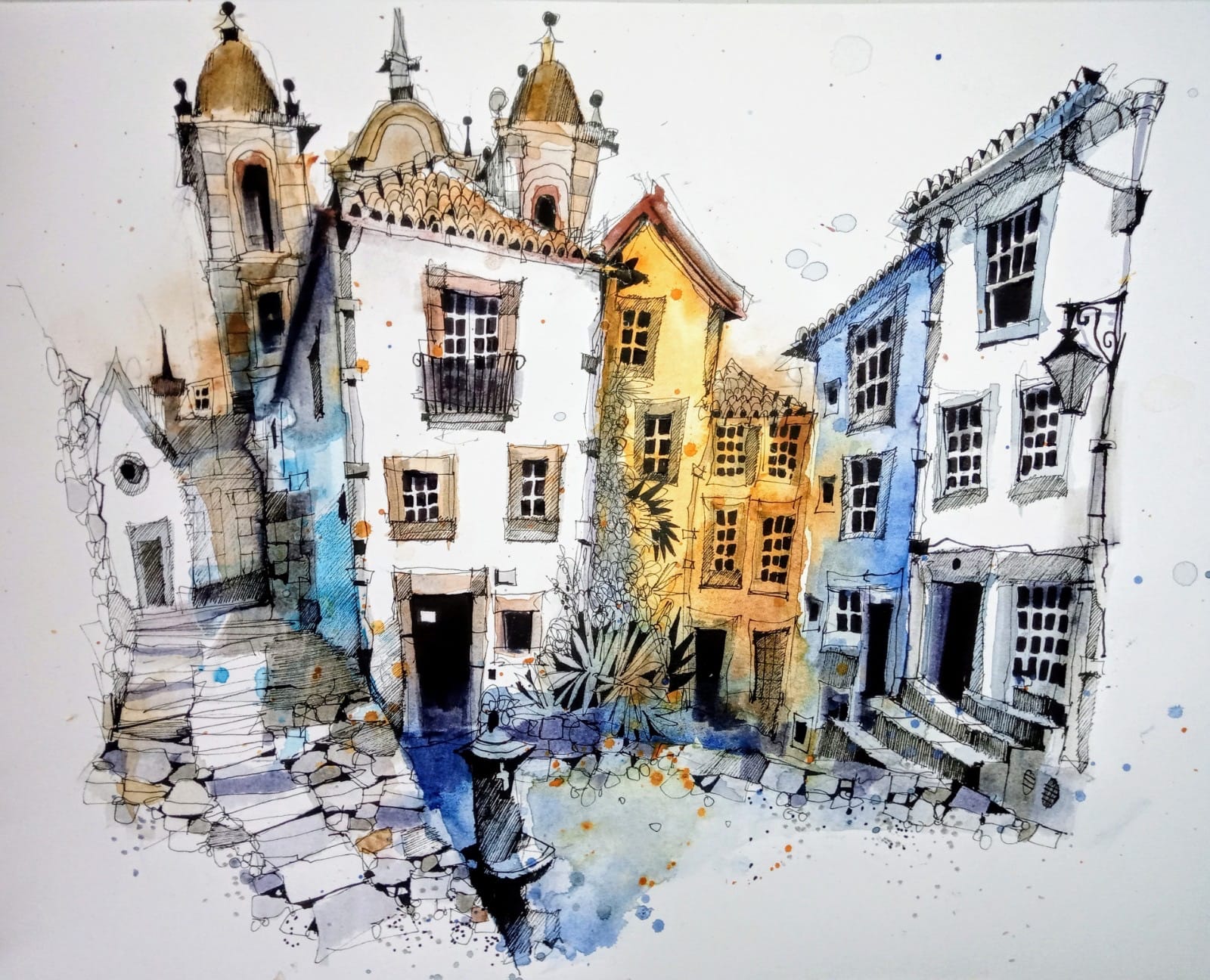
When should you use warm greys and when should you use cool greys?
This question comes up again and again in urban sketching, usually at the point where tone begins to carry more weight than line. A sketch can feel promising early on. The structure makes sense, the proportions are holding together, the colour is sitting comfortably. Then, as tonal areas start to build, something shifts. The page looks flatter than expected. A shadow feels heavier than it should. A wall suddenly reads as one large, dull shape.
That is often when the decision between a warm grey and a cool grey starts to feel bigger than it really is.
At that moment, it is easy to assume there must be a correct choice. That warm and cool greys belong to a system you are meant to understand before you are allowed to use them properly. In practice, that assumption tends to cause more hesitation than clarity.

The reality is much simpler. Warm and cool greys are not about following rules. They are about responding to what is happening on the page and using small temperature shifts to introduce visual variety, suggest material, and help the sketch feel believable rather than controlled.
Once you approach the question that way, it stops being intimidating and starts becoming genuinely useful.
Choosing warm or cool without overthinking it
The simplest and most reliable way to approach warm and cool greys is to stop treating them as a decision you need to get right in advance. They work best when they are used responsively, not strategically.
Many sketchers assume temperature is something you decide early, alongside colour choices. In reality, temperature decisions often come later, once tone starts shaping the drawing. A sketch might feel fine in line and colour, then lose energy once larger tonal areas appear. That is usually the point where warm and cool greys become relevant, not as theory, but as a way of breaking up sameness.
A helpful habit is to put tonal value first. Before asking whether a grey should be warm or cool, ask how dark it needs to be. Tonal value does the structural work. It tells the eye where things sit in space. If the value is wrong, temperature will not fix it. If the value is roughly right, temperature can quietly elevate it.

Two greys with similar tonal value can behave very differently in terms of feel. One might feel harder or cleaner. The other might feel softer or more weathered. Structurally they do the same job, but visually they suggest different materials and conditions. That difference becomes noticeable when it is repeated across a page.
This is why warm and cool greys are best thought of as options rather than answers. They give you flexibility. If an area feels stark, a warmer grey can soften it. If something feels muddy or heavy, a cooler grey can clarify it. You are not committing to a system. You are adjusting as you go.
Over time, this stops being a conscious decision. Warm and cool greys become part of your visual vocabulary, something you reach for instinctively because you have seen what they do.
Why buildings are Rarely one temperature
If you ever feel unsure about warm versus cool, it helps to slow down and really look at a building rather than naming it. Brick, stone, render, slate, concrete, painted wood. None of it is uniform.
Grime warms surfaces. Rain cools them. Reflected light shifts temperature constantly. Age introduces variation that no neat diagram can explain. Even on an overcast day, warmer patches sit beside cooler ones, sometimes within the same wall.

When a sketch looks overly tidy, it is often because this variation has been smoothed out. Everything has been described using one temperature of grey, even though the real surface is far more uneven.
Mixing warm and cool greys is not about inventing complexity. It is about allowing that unevenness back into the drawing. The aim is not realism in a photographic sense, but believability. The surface starts to feel like it has lived a life.
This is especially true in urban sketching, where age, wear, and accumulated detail matter as much as structure. A perfectly even wall rarely feels convincing. A wall with small temperature shifts often does.
How the Tombow grey palette supports visual variety
This approach becomes very practical when working with Tombow brush pens, because the grey palette is already divided by temperature.
The mid greys form the backbone of tonal work. The cool mid grey, N60, and the warm mid grey, N79, offer two ways of describing a similar tonal value. Neither is correct or incorrect. They simply feel different. One tends to read as cleaner or harder. The other often feels more earthy or worn.
The light greys are just as important. The cool light grey, N95, and the warm or creamy light grey, N89, are essential for softening edges, blending shadows, and pulling darker marks into form. They are often what stops tonal areas from looking blocky or overworked.
Rather than assigning each pen a fixed role, this set works best when treated as a small family of related tones. You move between them depending on what the sketch needs at that moment.

Observation often nudges choices in a particular direction. Warm greys, such as N79 and N89, frequently suit earth-based textures or areas that feel warmer. Worn brick, sandstone, dusty walls, or parts of a composition where light feels softer often respond well to warmer greys.
Cool greys, such as N60 and N95, often feel right for man-made structures. Stonework, slate roofs, metal details, or areas that feel harder and sharper often read more convincingly when described with cooler greys.
These are tendencies, not rules. A stone wall can contain both warm and cool passages. A roof can shift temperature across its surface. What matters is that the sketch reflects variation rather than uniformity.
Temperature can also be used to quietly link different parts of a drawing. Using the same warm mid grey on window frames and sandstone bricks, for example, can help those elements feel connected. The viewer reads the sketch as cohesive rather than fragmented, even if they cannot explain why.
Layering greys to build richer tone
Layering is where warm and cool greys really come into their own.
Placing the warm N79 over the cool N60, or the other way around, creates a darker, in between tone that feels far more natural than a single heavy pass. This kind of layered tone often sits beautifully in large wall areas or structural shadows, where a flat application can look dull or overworked.
Layering also allows you to adjust gradually. A light first layer gives you room to respond. If an area feels flat, another pass in a slightly different temperature can bring it back to life without overwhelming it. This makes the process forgiving. You are not locked into one decision or forced to push things too far too quickly.

Greys also play a crucial role over watercolour. Applied over dried colour, both warm and cool greys calm things down. They reduce brightness, add weight, and help the sketch feel grounded. Colour without tone can float. Greys anchor it and give it structure without stripping away character.
The choice between warm and cool affects the feel of that anchoring, but the main job is the same. The sketch moves from colourful to believable, which is especially helpful for those who enjoy watercolour but find it slightly unruly.
Making tonal decisions on the page
A practical way to work with greys is to keep things small and contained.
Choose an area such as a doorway, a window recess, or a section of wall. Put down a light layer of one grey to establish a base. Then add a second grey over part of that area, not all of it. Let the two overlap in places and leave other areas alone. You are looking for variation, not coverage.

Structural shadows are ideal places to practise this. Window frames, door recesses, and undersides of ledges respond particularly well to layered greys. A darker line pulled out with a lighter grey creates depth without harsh edges. Whether that lighter grey is warm or cool subtly changes the feel, but the main gain is the softened transition.
If shadows turn muddy, it is often because the tonal value has been pushed too far too quickly. Fewer dark areas usually improve a sketch more than adding more pen. Saving the darkest tonal value for places that truly need it brings clarity back.
If a sketch feels flat, check whether tone is evenly spread. Even tone often creates dull drawings. Concentrating tone where planes turn or forms overlap usually brings things back to life.
And if you are stuck choosing warm or cool, choose one and move on. A light first layer gives you room to adjust later. Hesitation often leads to heavier marks than confident movement.

Final thoughts on tone, temperature, and keeping sketches human
Warm greys and cool greys can sound technical, but in practice they are deeply human tools. They help you respond to what you see rather than forcing everything into a tidy system.
If there is one mindset worth keeping, it is this. Get the tonal value roughly right, then use temperature to add visual variety and support storytelling. Not dramatic storytelling, but quiet storytelling. The kind that suggests age, use, and atmosphere.
Try it in small areas. Layer lightly. Let some parts remain unresolved. Those moments of uncertainty are often where a sketch starts to feel real.
And when you notice yourself pausing over a grey pen, remember that the decision does not have to be perfect. It just has to move the sketch forward.
Ready to learn more?
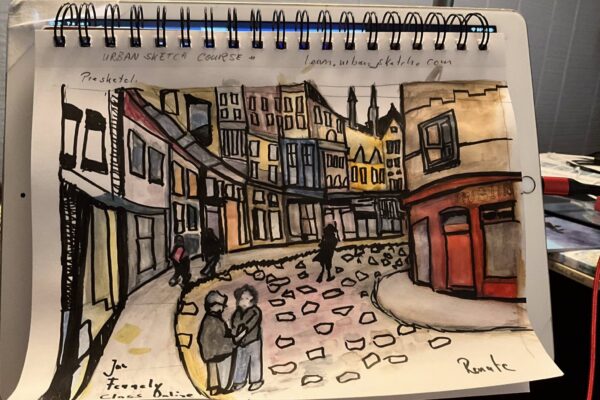
In our Urban Sketch PLUS membership, you’ll find dedicated lessons on tonal work – from layering greys and controlling contrast to blending brush pen and watercolour seamlessly. You’ll build the confidence to decide, instinctively, which tool to reach for next.