Why Perspective Matters When You Draw Buildings
Perspective is one of the most important skills for drawing buildings, streets, and urban scenes convincingly.
When perspective works well, buildings sit comfortably on the page. Windows align naturally. Streets lead the eye into the distance and the scene feels balanced.
When perspective is slightly off, something feels wrong straight away. Roof lines tilt. Windows climb uphill. A building can begin to look as though it might fall over.

The encouraging news is that perspective is not about complicated mathematics. It is simply the way our eyes interpret space. Once you understand the basic principles, perspective becomes much easier to recognise and use.
Most scenes can be explained using just three types of perspective:
one point perspective
two point perspective
three point perspective
These three ideas form the foundation for drawing buildings and streets with convincing depth.
One Point Perspective: Looking Straight Down a Street
One point perspective appears when you are looking directly toward the front of a subject or straight down a street.
In this situation, many of the lines in the scene appear to move towards the same place in the distance. This location is called the vanishing point.
The vanishing point sits on the horizon line, which represents your eye level.
If you stand on a street and look forward, you will notice several elements pointing towards that same point:
pavement edges
roof lines
rows of windows
road markings
building tops
In real life these lines are parallel, but visually they appear to converge as they move away from you.

When sketching, it helps to lightly imagine lines fanning outward from the vanishing point. These guide lines help organise the rest of the drawing.
They can be used to place:
window rows
floors in buildings
roof edges
pavement lines
Even a quick sketch can feel convincing when these elements follow the same directional flow.
One of the reassuring aspects of perspective is that the drawing itself does not need to be perfect. A sketch may be loose and expressive, but if the structural lines move towards the same vanishing point, the scene will still feel believable.
Perspective quietly holds the entire drawing together.
A Simple Exercise to Try
Stand at the end of a street or look down a long corridor.
Notice how the pavement edges, window rows, and roof lines all appear to point towards the same place in the distance.
Lightly sketch those direction lines first before drawing the buildings themselves.
Many perspective problems disappear once these simple guide lines are in place.

Two Point Perspective: Drawing the Corner of a Building
Urban scenes often show buildings from an angle rather than straight on. When this happens, we can see two sides of a structure at the same time.
This creates two point perspective.
Imagine standing at the corner of a building. One wall stretches away to the left. The other stretches away to the right. Each set of lines heads toward a different vanishing point.
Instead of one vanishing point, there are now two.
Both points still sit on the horizon line, but they are often far outside the edges of your sketchbook page. You may not draw them directly. Instead, you simply sense the direction the lines are heading.
For example, on one side of the building you might see:
roof edges
window rows
brickwork lines
wall tops
These all move towards the same vanishing point.
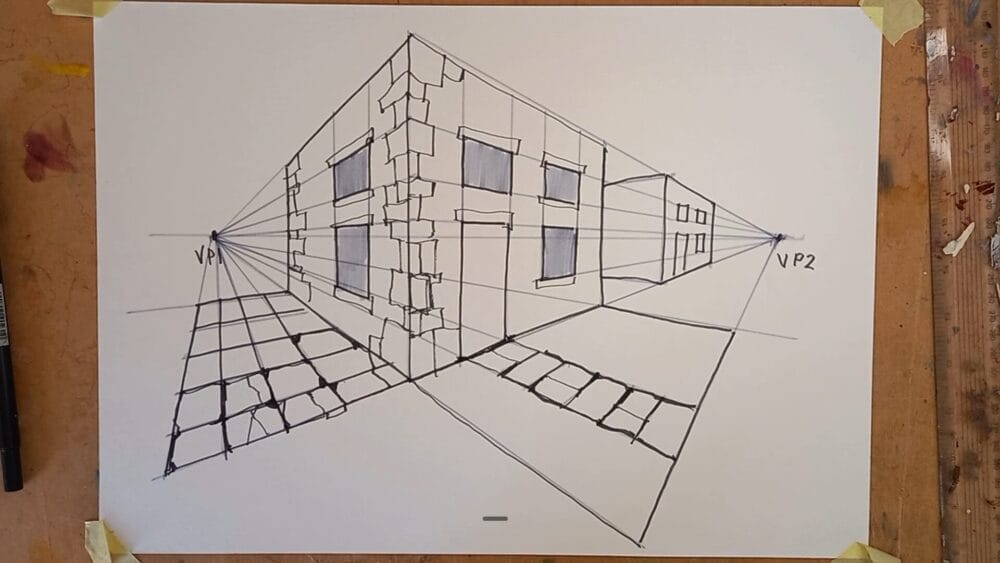
On the other side of the building, the same elements move towards a second vanishing point.
Many surrounding features also follow these directions. Pavement edges, garden walls, and roof beams often align with the same visual flow.
When you start recognising these relationships, even complex architecture becomes easier to organise. Most buildings can be simplified into two surfaces meeting at a corner.
Once that corner is established, the rest of the structure begins to fall naturally into place.

Three Point Perspective: Looking Up or Down
Three point perspective appears when the viewpoint changes dramatically.
This usually happens when you are looking up at very tall buildings or looking down from a high position.
In these situations, vertical lines begin to behave differently.
Instead of staying completely vertical, they appear to angle slightly as they move away from you. This creates a third vanishing point.
In three point perspective:
two vanishing points remain on the horizon line
a third vanishing point sits either far above or far below the drawing

When looking up at tall buildings, the vertical edges appear to move towards a vanishing point high above the page.
When looking down from a high viewpoint, the vertical edges appear to angle towards a vanishing point below the page.
This effect often appears in cities with tall architecture. Skyscrapers and towers naturally create this type of perspective.
Three point perspective adds a strong sense of scale and drama. Buildings can feel towering and impressive, and the viewer gains a stronger sense of height and depth.
Using Line Weight to Reinforce Perspective
Perspective is not only controlled by geometry. The way lines are drawn can also strengthen the illusion of depth.
One useful technique is varying line weight.
Objects in the foreground often benefit from slightly thicker lines. These lines help them feel closer and more prominent.
Elements further away can be drawn with lighter, thinner lines. This pushes them gently into the background.
For example:
paving stones near your feet might be drawn with stronger pen lines
distant buildings might be sketched more lightly
background textures such as brickwork or windows can be suggested with finer marks
This variation in line weight supports the sense of space within the drawing.
Many urban sketchers naturally use this approach by switching between pen sizes or adjusting the pressure of the pen.
Foreground details feel bold and confident. Background details become lighter and more subtle.
Together they help the scene feel deeper and more dimensional.

Training Your Eye to See Perspective
Perspective improves with practice, but more importantly it improves with observation.
The more you draw, the more your eyes begin to recognise patterns in architecture. Roof lines repeat. Pavement edges align. Window rows follow predictable directions.
Gradually you begin to see how the elements of a scene connect to the same invisible structure.
One helpful technique is checking angles before committing to a line. By holding your pen against the scene, you can compare the angle you see with the one you intend to draw.
Over time this simple habit trains the eye to recognise perspective relationships more accurately
The more you draw, the more your eyes are trained to see correctly, and that includes perspective. What helped me in the beginning, and what I still do with every sketch, is pen placement; it helps me see the angles of the lines better.
– Student Anja S
This idea reflects something many experienced sketchers discover. Perspective becomes easier not through memorising rules, but through repeatedly observing real scenes.
With practice, the eye begins to recognise the correct angles almost instinctively.

Final Thoughts
Perspective can feel intimidating when first learning to draw buildings and streets.
In reality, most scenes can be explained using just three ideas.
One point perspective appears when lines converge toward a single vanishing point. Two point perspective appears when a building corner introduces two directions of space. Three point perspective appears when vertical lines begin to converge due to height or viewpoint.
Once you begin recognising these patterns, urban scenes become much easier to organise.
Buildings sit more confidently on the page. Streets stretch naturally into the distance. The entire drawing feels more balanced and believable.
And like many aspects of sketching, improvement comes through repetition. Each sketch trains the eye a little more.
Over time the lines begin to fall into place, and perspective becomes a quiet ally in every drawing.
Ready to learn more?
Inside Urban Sketch PLUS, you will find clear lessons that help you understand and apply perspective in a calm, practical way. You can join member webinars and group discussions where we break down one point, two point, and three point perspective using real scenes. You will also be able to learn from student critiques, so you can see what works, borrow simple ideas, and use the same approach in your own sketches.