
Course Details
There is a moment most sketchers know well.
You are looking at a scene – buildings cascading down a hillside, boats crowding a harbour, colour and detail everywhere – and you want to sketch it.
But the sheer complexity feels like a wall. Too many decisions. Too many colours. And so you photograph it, close the sketchbook, and tell yourself: maybe next time.
Sketch Italy is Ian Fennelly’s answer to that moment.
Five workshops filmed on location in Riomaggiore, one of Italy’s Cinque Terre villages, using the most broken-down, step-by-step process Ian has ever built.

Ian's Most Broken-Down Process Yet
There is one reason sketchers freeze at complex scenes.
It is not talent. It is not confidence. It is not the wrong teacher.
It is that the process they were handed has too few stages between the blank page and the finished sketch. Too many decisions, all at once, with nothing to lean on between them.
A sketcher with a stage for every decision never freezes.
For the first time, every stage is split into two parts. There is a brand new VBS planning step. A new learning-line technique. Pre-sketches are complete workshops within themselves. And each core workshop uses just three colours.
It all exists to give you one more stage to stand on when the next decision comes.
The result? You sit down in front of scenes you never thought you could sketch. And you sketch them.
Here are the five workshops you will get instant access to in Sketch Italy:
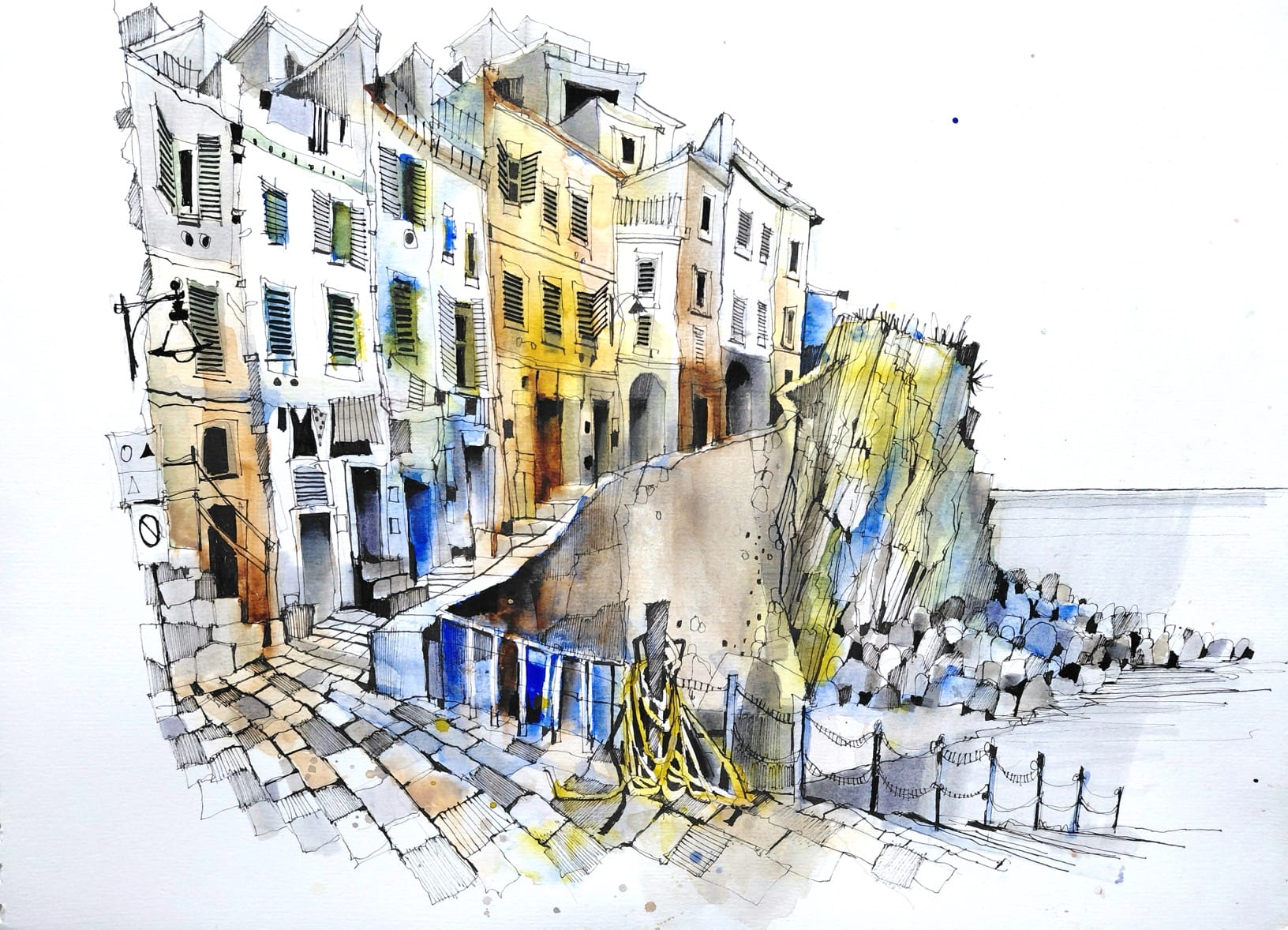
Workshop 1: Quayside
Warm stone tumbles down toward the water. Buildings lean against each other like old friends, stacked in that careless way Italian harbours do.
Below, the slipway cuts a sharp diagonal, pulling your eye from the clustered rooftops all the way to the harbour edge. You can almost feel the heat rising off the stone, hear the gentle knock of water against rock.
Something happens in this workshop that changes the way you put marks on paper. Not a technique, exactly. More like a way of seeing that, once you have it, you cannot unsee.
Ian introduces a concept so simple it sounds almost too obvious, and by the end of the workshop it will be yours. Three colours will do what you would have sworn needed twelve.
And you will understand exactly why he chose to leave certain things out of this sketch, and how to make the same choices in your own work.
By the end of Workshop 1, you will have a completed sketch of an Italian harbour scene in three colours, using a process you did not think was possible.
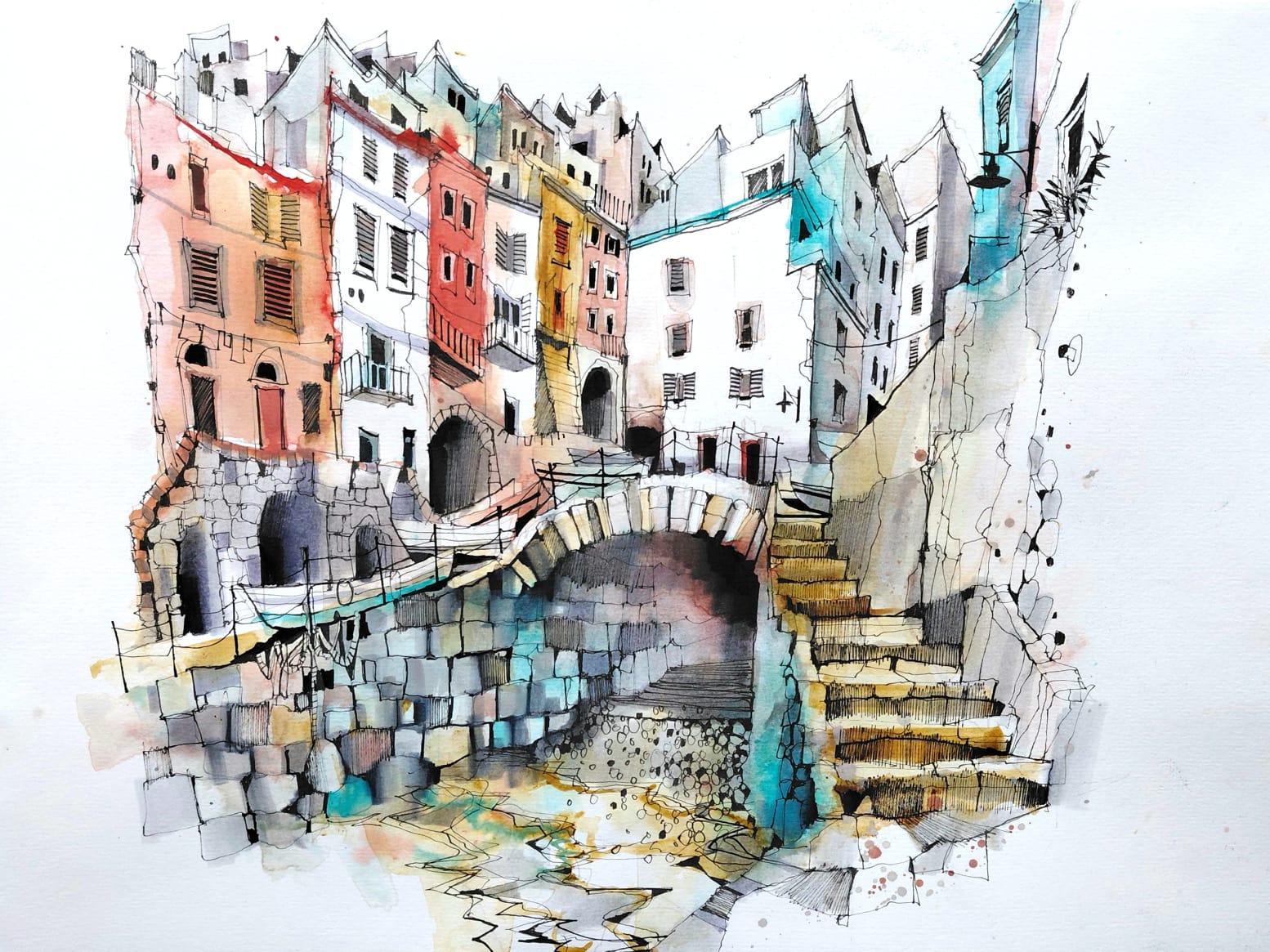
Workshop 2: Waterway Arch
A stone archway frames everything. Through it, water cascades down toward a shingly bay, and beyond that, boats sit at an elevation that makes you blink twice.
The architecture is not just scenery here, it is the skeleton of the whole composition, holding the chaos of water and stone and sky in a single, steady frame.
It is the kind of scene that makes you want to reach for a sketchbook before your brain catches up.
Ian shows you how to anchor an entire composition around one architectural element, and once you see how he does it, you will start spotting these anchors in every scene you look at.
He also does something quietly impossible in this workshop: he paints a building that is unmistakably pink, without using pink at all.
By the end of Workshop 2, you will know how to do the same, and you will understand why it works better than matching the colour you see.
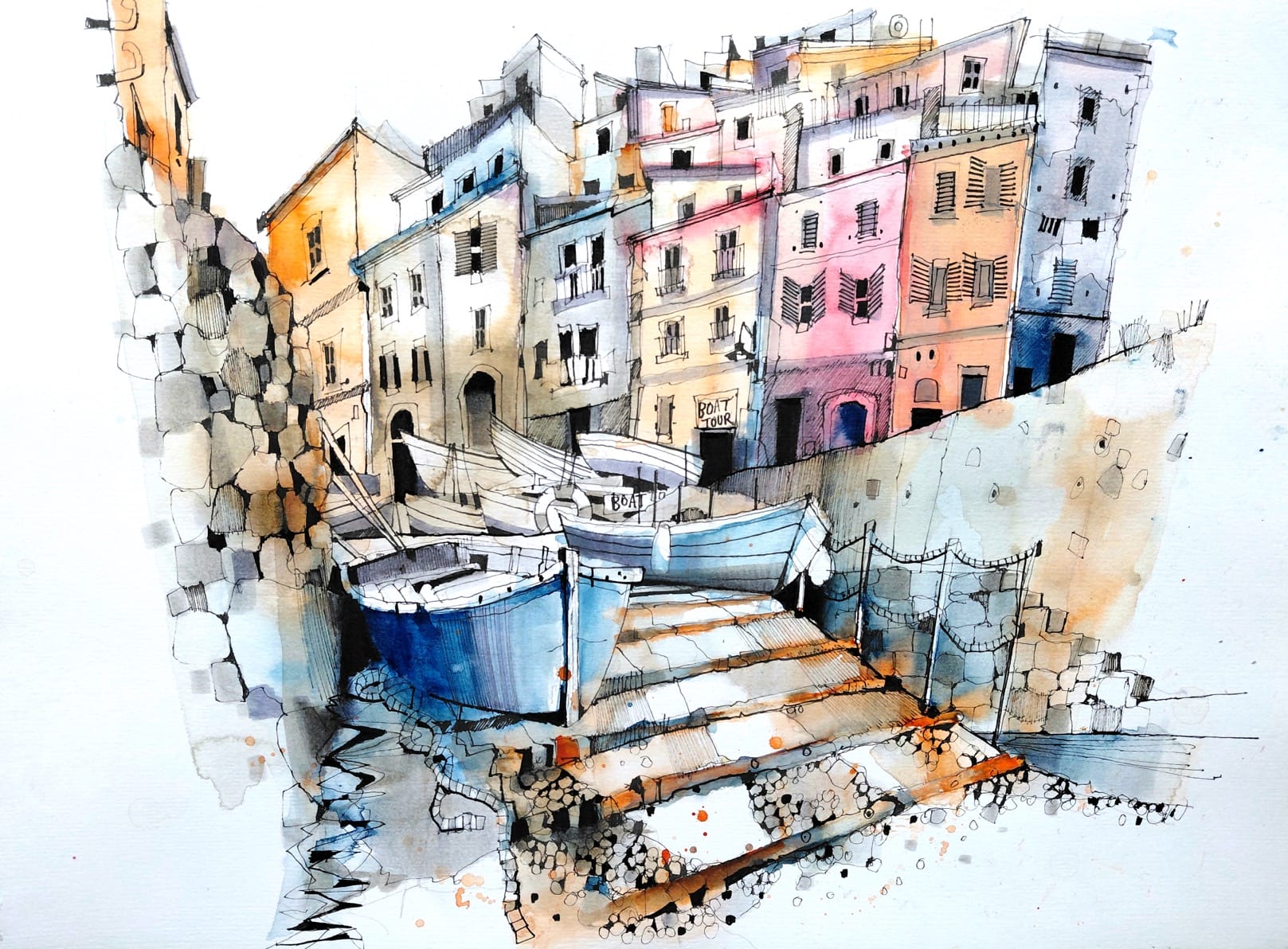
Workshop 3: Fishing Boats
Two blue fishing boats sit on the slipway, close enough to touch.
Behind them, the harbour crowds in, textured stone and weathered surfaces pressing the background right up against the foreground until there is almost no space between things.
Nothing here is simple. The boats, the stone, the tight composition, it all demands something from you. And that is exactly why Ian chose it.
Ian says something about colour in this workshop that will stop you mid-brush. It is one of those observations that sounds like it cannot possibly be right, and then you look at the sketch and realise it changes everything.
This is the workshop where the gap between drawing well and painting well quietly closes, and where you walk away with an approach to colour that will follow you into every sketch you do from here.
If those two skills have always felt like separate languages to you, this is where they start speaking to each other.
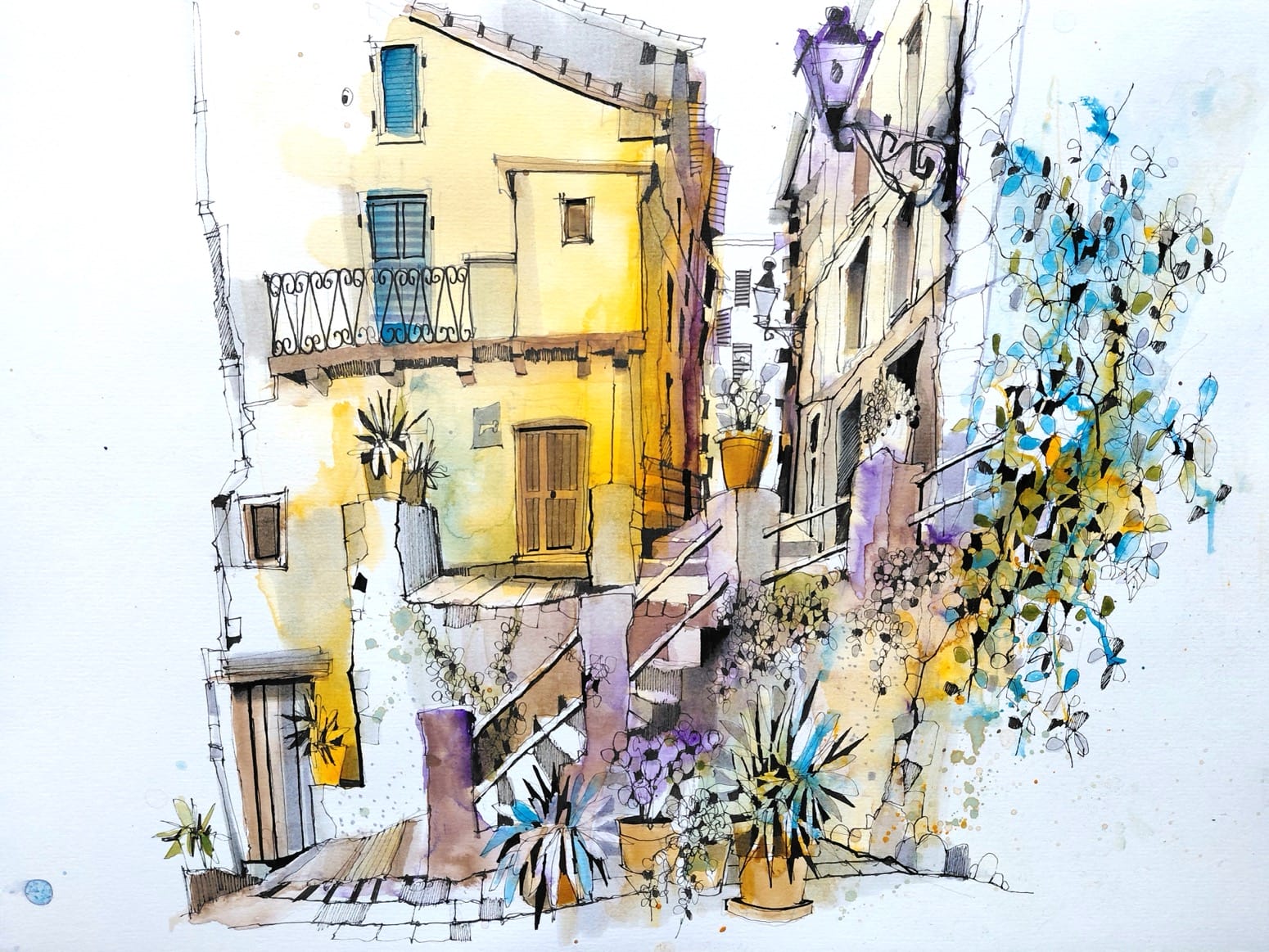
Workshop 4: Back Alleyway
This is not a grand scene. No sweeping vista, no famous landmark. A narrow back alley, some steps, plant pots clustered on a landing, vines trailing from a balcony, a lamp, crumbling plaster.
The kind of place you would walk straight past on your way to somewhere more photogenic. Ian sat down here on purpose. He calls it shabby chic, and he is not wrong, but what he finds when he really looks is something a postcard could never give you.
Sketchers consistently say this is their favourite workshop, and the reason is hard to explain without giving it away.
It has to do with what happens when you stop looking for the impressive subject and start looking at what is actually in front of you.
Ian shows you how the observation itself becomes the engine of the sketch, and by the end, you will have a completely different relationship with the scenes you have been walking past your whole life.
You will not expect this one to be the one that stays with you. Nobody does.
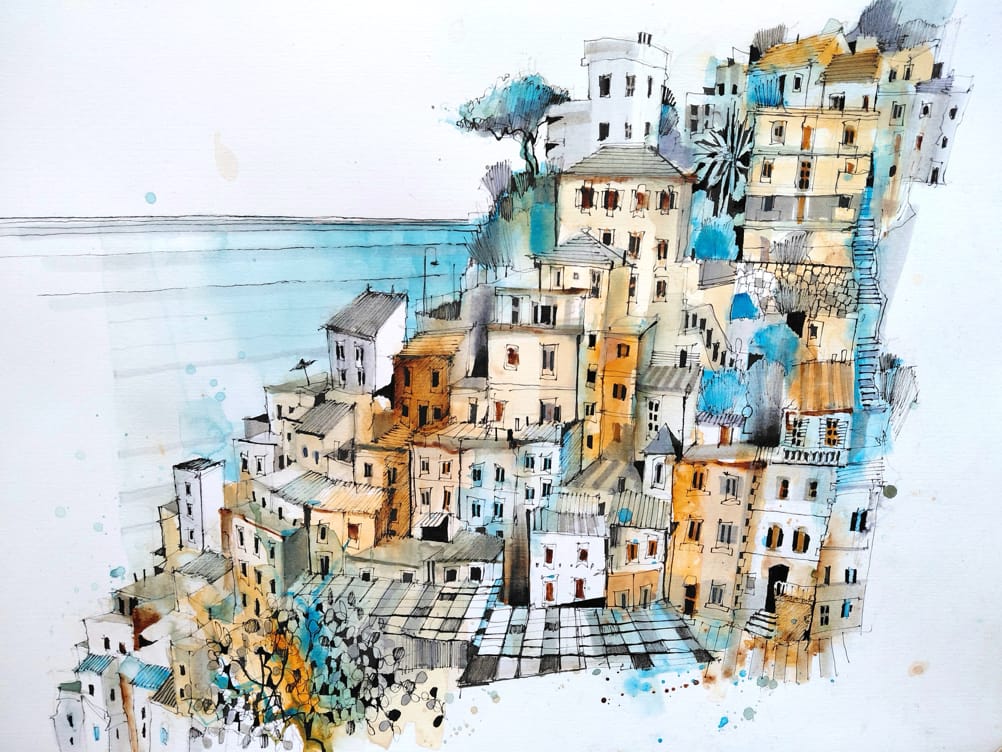
Workshop 5: Hilltop Panorama
The entire village tumbles below you. Clustered buildings cascade down the hillside toward the marina, rooftops overlapping, walls pressed together, the whole scene so dense and layered that your eye does not know where to land.
There is no obvious foreground, no tidy middle ground, no neat background. Just the overwhelming, beautiful mess of a real place seen from above. The kind of view that makes most people put their sketchbook away.
Ian shows you a way of starting a composition like this that is so simple you will wonder why it never occurred to you. By the end, you will have a technique for tackling any overwhelming scene, anywhere, not just this one.
You will not produce a precise record of what was there. You will produce something better: the feeling of what it was like to stand on that hilltop. And the difference between those two things is the whole point of this workshop.

What You’ll Be Able To Do After This Course
Every technique in Sketch Italy is designed to do one thing: give you the confidence to sit down in front of any complex scene and know you can sketch it.
Here is what Ian’s most broken-down process will teach you:
-
Breaking Down Complex Scenes
Learn Ian's new VBS planning step - a technique for mapping the big shapes on your page before making any committed marks on the paper.
-
The 3-Colour System
Each workshop uses just three colours, one from each primary family. You will discover how limiting your palette forces better mixing and produces automatic harmony - and why you do not need a full paint set.
-
Complementary Colour Mixing
Turn "mud" from your biggest fear into your most useful tool. When you mix two complementary colours together, the grey you get is not a mistake. It is the colour that ties your whole sketch together.
-
Tonal Value Over Local Colour
Stop trying to match the exact colour of every wall and shutter. Learn to match the tonal value instead - how light or dark something is - and watch your sketches gain depth and atmosphere with a fraction of the colours.
-
Authoring the Scene
A photograph bosses you around. A sketch does not. Learn to choose what goes in, leave out what does not serve the picture, and tell the story you want to tell.
-
The Split-Stage Process
Every stage is broken into two parts - more steps than any previous course. Each step builds on the last, creating a safety net around the whole activity. Ian also introduces "learning lines" - early marks that are allowed to be rough, helping you come to terms with the scale of everything before the committed marks arrive.

Why Ian Chose the Hardest Location He Has Ever Filmed
Riomaggiore is the southernmost village of Italy’s Cinque Terre – five tiny fishing villages carved into the cliffs of the Italian Riviera.
It is a place where pastel-coloured houses stack vertically above a tiny harbour, narrow alleyways wind between stone walls draped in vines, and every turn reveals a composition that makes your hand itch for a sketchbook.

Ian chose Riomaggiore because it is visually spectacular and relentlessly complex. Every scene contains more detail, more colour, more overlapping shapes than you would normally attempt.
That is the point.
He took the most challenging location he has ever filmed and built his most accessible process around it. The complexity of the place forced the simplicity of the method.
If you can sketch Riomaggiore with three colours and a step-by-step method that holds your hand through every stage, you can sketch anything.
The skills travel with you. Your own street. The town square on a weekend. Your next vacation. Italy is your virtual classroom. The method is yours to take anywhere.

Free Launch-Week Only Bonus Training Bundle
There's more. Ian created a series of additional training that didn't quite fit into the 5 workshops, but contain vital teachings.
Buy Sketch Italy during this special launch period and we'll include them along with your course completely FREE (Worth ).

BONUS 1: Complementary Colours Guide ( value)
Ian’s complete mixing exercise covering 6 complementary pairs. Watch him mix each pair, add white, and see exactly how two colours become the full tonal range you need for any scene.
Follow along, mix each pair, and watch “mud” become your new favourite colour.

BONUS 2: The Scene That Got Away ( value)
A scene-selection masterclass. Watch Ian walk through a location, explain why one scene does not work, and then find the composition that does.
This is the authoring mindset in action. Choosing what to sketch is half the skill.

BONUS 3: Changing the Scene ( value)
Watch Ian reject one scene and find a better one just 40 metres away.
“We’ve only moved up about 40 meters but suddenly that elevation is much more prominent.”
You will never look at a location the same way again.

BONUS 4: Quick Sketch Demo ( value)
A strictly timed, brush-pen-only speed sketch.
No watercolour, no planning, just five minutes of pure freedom.
Watch how adding constraints liberates you rather than limits you.

BONUS 5: Ian’s Sketchbook Journey ( value)
Ian talks through all five finished pieces from the course, sharing what worked, what surprised him, and the stories behind each sketch.
An intimate look at how everything comes together.

BONUS 6: Feedback Gallery Access ( value)
You don’t need to practise in private.
When you share a sketch in the Urban Sketch Gallery, other sketchers working through the same course respond.
It is the reason students who have abandoned courses before say they finished this one.
Total Bonus Value:
(INCLUDED FREE DURING LAUNCH PERIOD ONLY)
What Our Students Say About Ian's Teaching Methods:
Sketch Italy brings together everything that makes Ian Fennelly’s teaching unique – his warmth, his clarity, his ability to break impossibly complex subjects into steps you can actually follow – and applies it to some of the most beautiful and challenging scenes he has ever filmed.
Whether you have been sketching for years or you are just getting started, this course meets you where you are and takes you somewhere you did not think you could go.

Why This Course Matters for You
Think about the last time you stood in front of a scene and reached for your phone instead of your sketchbook. The buildings. The boats. The alleyways. The light.
You photographed it. You closed the sketchbook. You told yourself: maybe next time.
Then think about the time before that. And the time before that.
Six months from now, if nothing changes, the pile of “maybe next times” is larger. The sketchbook is cleaner. The story you tell yourself about why you are not sketching is louder. Another sketchbook with three tentative marks on page one and a hundred blank pages after.
Hundreds more spent on art supplies and courses
Or, a few weeks from now, you could be working through scenes exactly like these.
Sketchbook open. Three colours beside you. Planning on the page. Learning lines first, committed marks second. Mud mixing into the unifying grey. Ian’s voice in your ear explaining every step.
A few weeks from now, you are someone who sketches.
A completed Italy scene in your hands. Evidence that this is who you are now.
Start Today
INSTANT LIFETIME ACCESSOnly:
-
The Complete Sketch Italy Course (5 Online Workshops)
-
Pre-Sketch Training with Each Workshop
-
BONUS 1: Colour Guide ( Value)
-
BONUS 2: The Scene That Got Away ( Value)
-
BONUS 3: Changing the Scene ( Value)
-
BONUS 4: Quick Sketch Demo ( Value)
-
BONUS 5: Private Sketchbook Tour ( Value)
-
BONUS 6: Free Access to our Urban Sketchers Feedback Gallery ( Value)
-
Free Course Updates for Life
-
Forever Access (it never expires)
-
30-Day Money Back Guarantee
Frequently Asked Questions
Very – because this is Ian’s most broken-down course to date. Every stage is split into two parts, so you are never asked to take a big leap.
There is a brand new “VBS” planning step that helps you map out your page before making any marks.
And Ian demonstrates full pre-sketches for every workshop, so you can see the entire thinking process before you start your own. If you can hold a pen and follow along, you can do this course.
Yes. And here is why: you have probably been told that muddy colour is a mistake. In this course, Ian shows you that the grey you get when you mix two complementary colours is actually the most useful colour on your palette.
It is the colour that unifies your entire sketch – because it came from the colours already in your painting, everything harmonises automatically.
When you stop fighting the mud and start using it, your colour work changes completely. Three colours and their complementary mix can carry any scene.
What makes this course different is not the location – although Riomaggiore is spectacular.
It is the level of breakdown. Every stage doubled. A new planning step. Pre-sketches treated as first-class teaching content.
And a colour system so simple it will make you wonder why you ever thought you needed more than three tubes of paint (3 colours per workshop, complementary pairs, mud as the goal).
Ian has never taught this explicitly before.
If you have bought courses from other artist’s before and stopped, this is the important part.
You are not the reason those courses did not work.
Most sketching courses ask you to produce a finished drawing from a blank page. They teach a technique and assume you will supply the rest, the confidence to start, the structure to keep going, the patience to not quit.
The reason you stopped was not talent. It was that you were asked to hold 10,000 decisions at once, with nothing to lean on between them.
Ian has built Sketch Italy the other way around. The structure does the work you used to be asked to do alone. You show up. The next stage is always there to take.
Yes. This is over-the-shoulder learning with Ian Fennelly.
Ian is an experienced and engaging teacher and has broken each workshop down into easy-to-follow stages. Within each of those stages, he takes you through each step in the process while explaining everything he is doing, slowly and methodically.
You have the flexibility to slow down, pause, or speed up each tutorial to match your learning pace. Some students also prefer to watch the videos first and then watch them again and sketch along. The choice is yours!
Plus, with lifetime access, you can revisit the course as many times as you like.
There are only two ways to learn what you will learn in Sketch Italy.
1 – Fly to Italy and take a single in-person week-long sketching retreat with a teacher of Ian’s calibre for a week. Typically + meals and flights.
2 – Take Ian’s Sketch Italy course. Five workshops, every stage split in two, three colours, lifetime access, with a teacher who has guided 50,000+ students across 188 countries. . Once. Forever.
If you have been at this for a while, you have almost certainly spent more than on things that did not work. A subscription you did not use. A weekend workshop that inspired you for three days. A watercolour kit that sits in a drawer. A book or three that live on the shelf.
None of those were your fault. They were not built for what you actually needed.
No. Ian works with a compact kit – a sketchbook, fine liners, Tombow brush pens, and a small set of watercolour paints.
Each workshop uses only 3 watercolours. You do not need a full pan set. The whole point of the limited palette is that fewer colours produce better results.
The course is organised into short, manageable lessons across five workshops.
With lifetime access, you can proceed at your own relaxed pace and on your schedule. And repeat any lessons as often as you like.
Yes. We call it forever access.
It never expires, which allows you to learn at your own pace, on your schedule, and on any device.
What’s more, if we update the course with new segments, trainings, downloads and more. You’ll get those included too at no additional cost.