When Your Palette Looks Different: Embracing Flexibility
You’ve set out your sketchbook, your brush pen’s ready, and your water pot’s full – but when you reach for the paints, something’s missing. No Prussian Blue. No Cobalt Turquoise Light. And what on earth even is Green Gold?
Here’s the good news: you absolutely do not need to have an identical set of paints to sketch like yourself – or to follow along with Ian. His approach was never about copying colours swatch for swatch. It’s about capturing a location with storytelling, observation, and mindful use of tone and colour. And that means there’s plenty of wiggle room.
Ian often reminds us that colour choice is more about personality and feeling than technical loyalty. It’s not about painting what’s there so much as what’s felt. So if your palette looks a little different from Ian’s, don’t worry – that’s not a problem, it’s an opportunity. You’re not at a disadvantage – you’re simply sketching with a different voice.

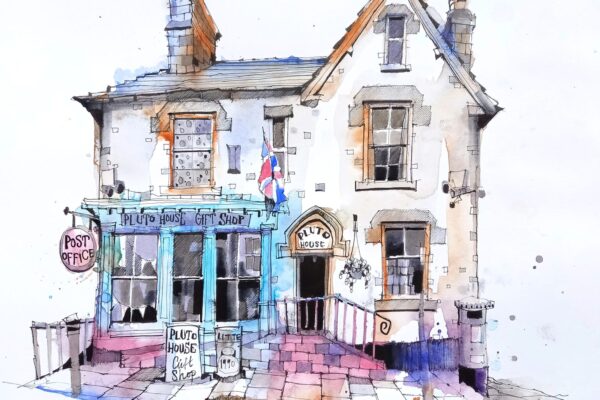
Gift Shop from High Street Highstreet Course. I didn’t have the suggested manganese blue, so I used cadmium yellow.
– Beth W
Tonal Value Matters More Than Exact Colour
Here’s something Ian returns to again and again: the value (that is, the lightness or darkness of a colour) is more critical than the hue itself. If you squint at a sketch and all the light and darks feel balanced and intentional, your viewer won’t care whether you used Prussian Blue or Payne’s Grey.
Let’s say you don’t have Burnt Umber. Could you use Indigo or a deep green instead, as long as the tonal value is right? Absolutely. Ian’s workshops teach us to think less like rule-followers and more like visual problem-solvers.
A dark red might do the job of a brown. A strong yellow could pop in place of Transparent Orange. The real challenge is learning to see value before worrying about matching colour. Try taking a black and white photo of your palette. Do your light, mid, and dark tones stand apart? That’s what matters.
Tried-and-Tested Substitutes: Mixing with Confidence
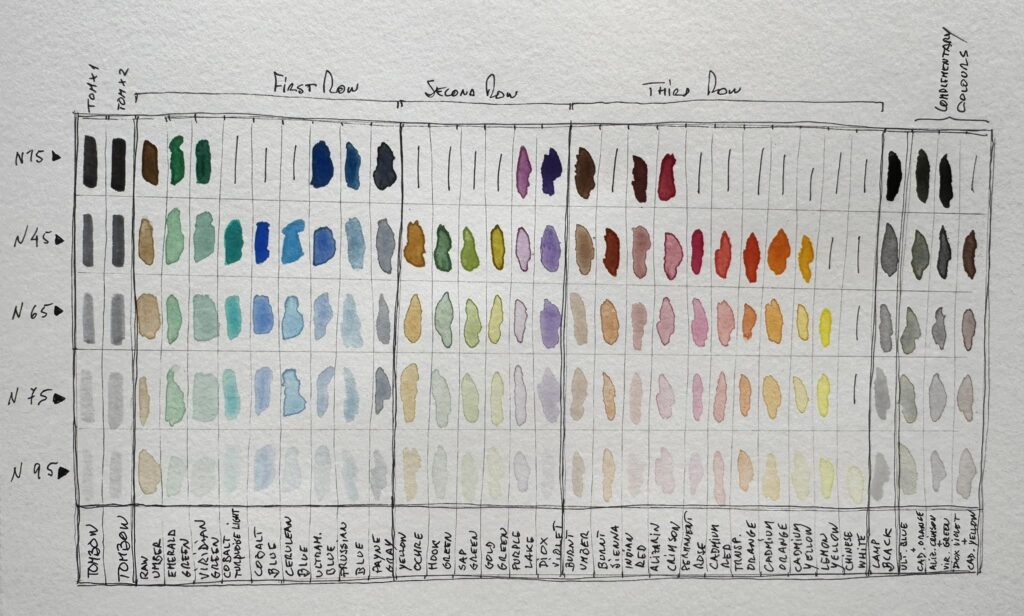
When you’re missing a specific colour, don’t panic. Here are workable substitutes for Ian’s most commonly used Winsor & Newton paints – along with tips for mixing your way there if you’re building from a limited palette.
Prussian Blue: Swap in Winsor Blue (Green Shade) or Phthalo Blue. Both offer deep, cool intensity. To mix a close match, try Ultramarine Blue plus a touch of Viridian or Phthalo Green to cool it down and deepen the tone.
Ultramarine Blue: If you don’t have this rich, warm blue, try French Ultramarine or mix Cobalt Blue with a small amount of Alizarin Crimson for a purplish warmth.
Manganese Blue: A gentle, airy blue. Cerulean Blue is your best bet here. Alternatively, try a small amount of Cobalt Blue mixed with white and plenty of water to achieve that pale, light feel.
Cobalt Turquoise Light: No perfect swap, but try Turquoise mixed with white or water for softness. Alternatively, mix Phthalo Blue with a touch of Lemon Yellow and white to approximate that minty freshness.
Green Gold: Quinacridone Gold is a warm golden-yellow with a subtle earthy undertone.To mix your own alternative, combine Lemon Yellow with Raw Sienna or Yellow Ochre, and add a tiny amount of blue or green for a mossy twist.

Burnt Sienna: Burnt Umber shares the same earthy family, though it’s cooler and less red. You could also try Indian Red, which uses the same pigment but has more opacity and a stronger red tone. Or mix Orange with a bit of Ultramarine Blue for a homemade earthy tone.
Burnt Umber: Van Dyke Brown works well, or create your own by mixing Ultramarine Blue with Burnt Sienna or Red Oxide – push the proportions until you find your perfect dark neutral.
Winsor Violet: Dioxazine Purple is a great substitute. If you want to mix it yourself, try Alizarin Crimson with Ultramarine Blue, gradually adjusting the ratio to control warmth.
Alizarin Crimson: Permanent Rose or Quinacridone Magenta works well. To mix your own, try a deep red like Cadmium Red with a small amount of blue for depth.
Cadmium Red: Try Scarlet Lake or Pyrrol Red. To mix, combine a warm red like Vermilion with a hint of orange or yellow.
Transparent Orange: Any bold orange will do. To mix it, try Cadmium Red with Cadmium Yellow Light or mix Scarlet with Lemon Yellow in a 2:1 ratio.
Indian Yellow: Mix Cadmium Yellow Deep with a small amount of Quinacridone Rose or Burnt Sienna to reach that rich golden hue. Gamboge is an excellent ready-made alternatives.
Don’t be afraid to experiment. Try each mix on scrap paper and label the result. These become little colour maps for your future sketching sessions.

Mixing and Matching: Trusting Your Eye and Palette
When you mix from a limited palette, you’re doing more than creating colour – you’re enhancing your observation and storytelling skills. Ian often uses just three to five colours plus white, pushing those pigments to do heavy lifting.
Try this: pick one blue, one red, one yellow, and white. Start mixing. You’ll find you can create rich neutrals, unexpected secondaries, and subtle tonal variations that feel more you than any pre-set palette ever could.
Use the sketchbook page beside your drawing for test mixes. That scrap becomes your reference chart, your rehearsal space, your colour memory. You might discover a mixed green that sings louder than any Green Gold. Or that your hand-mixed grey softens the way Ian’s does when white is added with just a bit of water.
Complementary colours – such as orange and blue, or red and green – are also worth exploring. When mixed, they mute each other into beautiful greys and browns. These neutrals are incredibly helpful for balancing brighter areas in a sketch, and they harmonise with your palette because they’re built from what’s already there.
And then there’s white. Not the forbidden fruit some old-school watercolourists warn you about, but a powerful way to tone, mute, and control your mixes. It adds body. It softens edges. It calms chaos. Ian uses it often, and so should you if you feel your colours need taming.

Letting Colours Play: Embracing Mess and Magic
One of Ian’s greatest gifts to us is permission to let the colours do their own thing. Bleed. Bloom. Shift. React. He often paints wet-on-wet, pushing pigment across the page, letting happy accidents take root.
So don’t fuss if your violet runs into your orange. That’s where the sketch becomes alive. Brush pens reawaken pigment beneath, adding new personality each time they move. Try to use the same colour mix in multiple areas of your sketch to tie everything together. That makes your scene feel intentional, even if the colours weren’t what you planned.
Even using colours that don’t quite ‘match’ the subject can lead to unexpected surprises. A grey building might come alive with turquoise shadows. A streetlamp might pop with unexpected warmth if you added a bit of orange.
If you’ve got leftover mixes on your palette, don’t waste them. Look for ways to echo that colour elsewhere in your sketch. It creates rhythm and cohesion without the need for perfection.

Choosing Colour as a Storyteller, Not a Technician
Ian doesn’t use colour to document photographically. He uses it to communicate. He might paint Brighton Pier with a blast of turquoise and violet, not because that’s what he sees, but because it feels energetic and fresh. That’s storytelling through colour.
So here’s your invitation: when you don’t have the “proper” colour, ask what feeling you want instead. Replace the technical itch to match with a conscious choice to express. If your town square feels warm and lazy, maybe a cool blue wash says more than a brick red ever could.
Urban Sketching isn’t about being literal. It’s about slowing down, observing, and letting the colours reflect your interpretation of the place. That’s mindful sketching at its best.
Think of your palette not as a constraint, but as a starting point. Limited colour can simplify decisions and sharpen your eye. You’ll begin to notice subtle warm/cool differences and tonal contrasts that make your sketch more interesting. And those limitations often lead to a stronger, more cohesive outcome.
Final Thoughts: Keep Sketching, Keep Exploring
Urban sketching isn’t a paint-by-numbers hobby. It’s a way of seeing the world with heart and curiosity. Missing a colour or two won’t stop that. In fact, it might just lead you somewhere new.
So go ahead. Substitute. Mix. Invent. Make peace with muddy patches. Laugh at dodgy shadows. And keep going.
The more you explore your own colours, the more confident you become. Share your sketch, your swaps, and your stories in the community – because every colour choice tells us something about how you see the world.
Ready to learn more?
If you are looking for inspiration and practical examples of limited palettes in action, check out Ian’s Colour Chart Book. This book showcases his favourite limited-palette combinations and provides insights into how he balances warm and cool hues for maximum impact.
By embracing the benefits of a limited palette, you can simplify your workflow, create more harmonious sketches, and gain a deeper understanding of colour mixing. So why not give it a try and see how fewer colours can lead to more creative freedom?