
The Cobbles That Taught Us Perspective
- Blog
- June 9, 2026
- 24 mins
A Steep Little Slipway in an Old Smuggling Village
There’s a slipway at the bottom of Robin Hood’s Bay, a steep cobbled ramp that runs down between two high sandstone walls and spills out onto the sand. If you’ve ever stood at the foot of it and looked back up, you’ll know the feeling. The whole village seems to tip toward you. The rooflines lean in. The cobbles run uphill in a great sweep, and somewhere near the top a tiny arched bridge sits at the centre of it all like the eye of the whole scene.
Ian Fennelly filmed a workshop on exactly that spot, standing on the beach with his sketchbook, looking up. And the thing he kept coming back to, again and again, was perspective. Not as a dry rule from a textbook. As the living thing that makes a flat sheet of paper suddenly feel like a place you could walk into.
We want to tell you about it, because perspective is the one skill most self-taught sketchers never quite crack, and this old fishing village is where Ian teaches it best.

Why perspective is the thing that quietly defeats people
Most people who teach themselves to sketch can draw a window. They can draw a door, a chimney pot, a nice wobbly line. What trips them up is space. The drawing looks fine, and yet it sits flat on the page, like a stage set with no depth behind it. Something is slightly off and they can’t name what.
What’s missing, almost always, is perspective. It’s the difference between a row of buildings that looks painted on a wall and a street you feel you could walk down.
This is rarely a talent problem. It’s a seeing problem. Nobody ever showed them how to look at the lines that are already there in the scene, the ones doing all the quiet work of pulling your eye back into the distance. Once you can see them, you can’t un-see them. And Robin Hood’s Bay, with its tipping rooflines and its cobbles that change direction as they climb, is one of the best teachers of that looking we know.

What Ian actually looks at
Stand where Ian stood, at the foot of the slipway, and the first thing he notices is the cobbles. Not as decoration. As direction.
“There’s some really amazing perspective going on here, ’cause the direction of these stones just changes very dramatically,” he says, marking out the first faint lines. The stones near the bottom are round and worn and random. As they climb the slope they tighten into more regular blocks, the ones a passer-by once told him are properly called sets, and they shift their angle as they go. The cobbles are not a texture to fill in at the end. They are the structure of the whole drawing.

Then he looks up at the buildings, and he finds the lines that are radiating away from him. This is the heart of it. “If you look at the Bay Inn Hotel now, you can see how the top line here, that top elevation line, and this kind of bottom line are all radiating towards our vanishing point over here,” he says. The same on the opposite wall. The same on every roof and every windowsill. All those lines, which in real life are perfectly level and parallel, appear to lean and gather as they run away from you, until they meet at a point you cannot see.
That point is the vanishing point. And everything that leans toward it is doing one job. “That is leading us back into the scene, the focal point in the center, which is this small, cute little bridge.” The eye follows the lines home.
""So perspective is really, really crucial to this kind of thing.""
– Ian Fennelly
Hatching That Follows The Slope
Here is the part that tends to make the penny drop for people.
Once the line work is in, Ian could stop. A lot of artists would. “A lot of artists I very much appreciate would feel at this stage the drawing’s finished,” he admits. But he likes to push on, and the way he pushes is with hatching, those small repeated pen strokes that build up tone.
The clever bit is the direction he hatches in. He doesn’t scribble shadow in randomly. He makes the hatching follow the slope. “If I do hatching now, for example, and the hatching follows the contours of the perspective, you see, it’s kind of exaggerating even further that movement of all of these stones going up the slipway.” The marks themselves climb the hill. “So you see how I’m using the hatching technique as a way of exaggerating the perspective. It’s all kind of converging back onto the vanishing points.”
So the shading isn’t just darkness. It’s depth. Every little stroke is quietly leaning the same way as the cobbles and the rooflines, pulling the whole scene back into the page. That’s the moment a flat drawing stands up and becomes a space.

The gaps matter as much as the stones
There’s a generous, freeing idea tucked inside all of this, and it’s very Ian. Perspective isn’t about precision. It’s about noticing.
When he walks you through the cobbles, he points just as much at the spaces between them as at the stones. “It’s about the gaps in between because the gaps vary and also the shape of them vary. But also the direction of them changes as well. So trying to achieve that kind of perspective is gonna be really challenging but also really interesting. And it’s gonna help us to structure the picture down at the bottom.”
And the marks themselves stay loose. He describes drawing one run of stones as “kind of like taking a line for a walk. Just a wobbly wobbly line.” That’s the whole spirit of it. You’re not drafting an architect’s diagram. You’re following the lines the village hands you, leaning them gently toward the vanishing point, and letting your hand be human while you do it.

Why a smuggling village teaches it so well
Robin Hood’s Bay is an old fishing village, all hidden steps and leaning cottages, the kind of place that ran with smugglers and salt and stories. The Laurel Inn sits up in the old village. The Smugglers pub, with its anchors on the shutters because, as Ian notes, it’s a fishing village, sits down near the bottom.
That tangle of buildings is the gift. When Ian sketched the Smugglers, he built the whole composition around perspective on purpose. “We’re really trying to focus on perspective at the moment,” he says, choosing to draw the front of the pub flat and then let the scene fall away on both sides. “The front elevation of the pub is gonna be framing the perspective on either side.” On the right, a flight called Tysons Steps, which he was excited to draw for one reason only. “Not because it’s Tysons Steps, but just because it’s steps with some really strong perspective going on.”

A village built on a hill can’t help but teach you depth. Every street leans. Every roofline runs away to a point. You couldn’t design a better classroom.
And that’s the quiet promise of it. Once you learn to see these lines here, you carry the seeing with you. The skill doesn’t stay in Yorkshire. It comes home with you, to your own street, your own kitchen window, the view down your own road. Robin Hood’s Bay is simply where the looking is easiest to learn.
If you’ve been sketching for a while and felt that flatness in your work without being able to name it, perspective is almost certainly the missing piece. It’s the heart of what Ian teaches in his Robin Hood’s Bay workshops, and it’s the kind of thing that, once you understand it, changes how you see every street you ever stand on.
Ready to learn more?
If you’d like to see how Ian teaches all of this in full, the Robin Hood’s Bay Sketching Course is built around exactly this skill. It’s a standalone course, filmed on location, that walks you from the first faint construction lines to the finished hatched drawing at your own pace. You don’t need prior experience, special materials, or perfect results. Just a sketchbook, a willingness to look closely at the lines a place hands you, and the time to let each drawing develop layer by layer.
The Cobbles That Taught Us Perspective


About the Artist
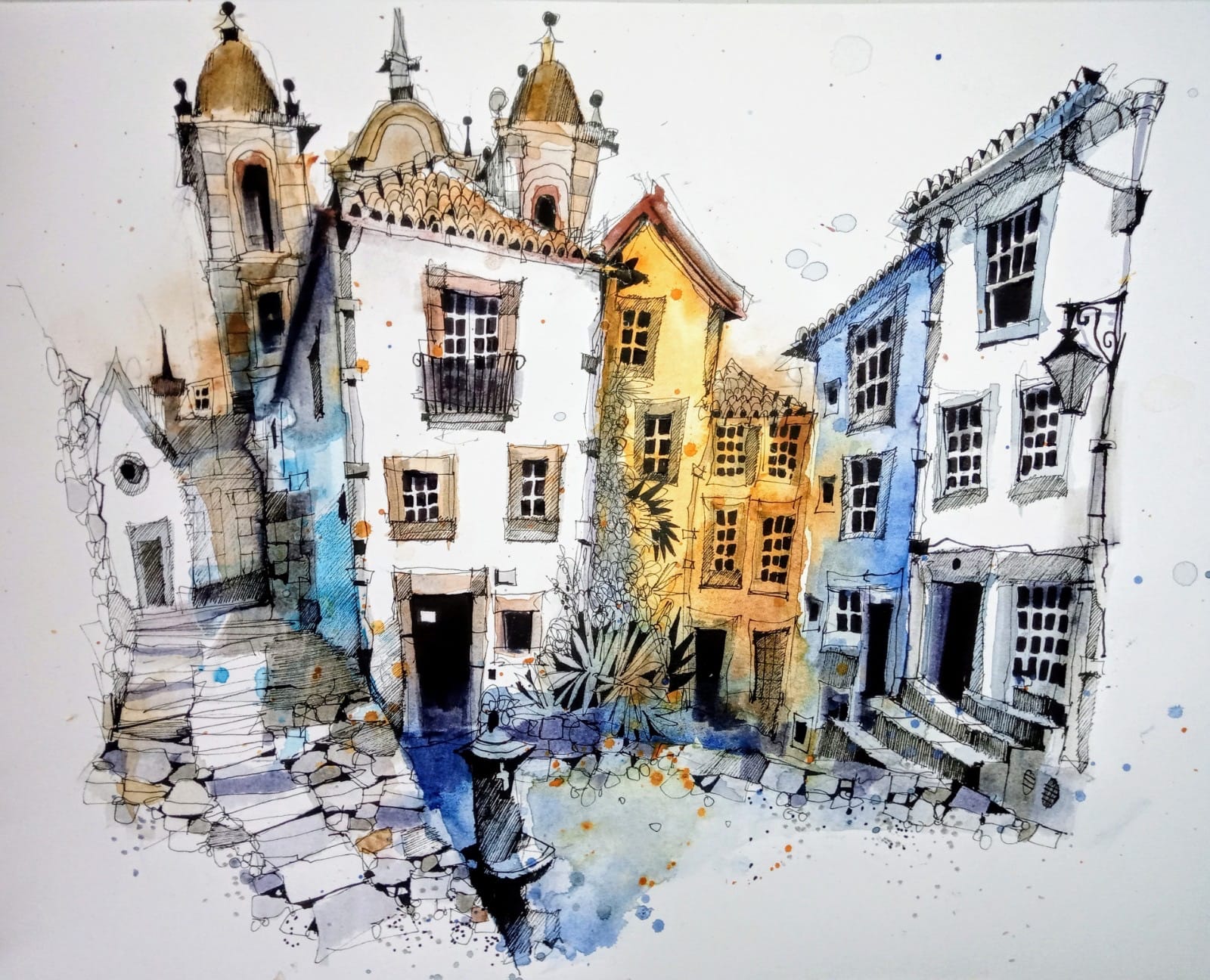
Ian Fennelly focuses on capturing urban spaces and environments by drawing the places where people have been without actually including them.
His process involves layering watercolors, brush pens, and liners to build depth, texture, and detail, allowing them to fully immerse in the scene while adapting to changes in their surroundings.
About Urban Sketch Course
- More Blog Posts -
- 26 mins
- 33 mins
- 13 mins
- 28 mins